

Why Your Business is Failing at Agentic AI: The Infrastructure Lie
Agentic AI isn’t about better prompts; it’s about better infrastructure. You’ve been lied to about what it takes to scale. Most of what you’re reading right now is useless, written by people who’ve never built anything that actually has to perform. They treat these tools like digital toys and wonder why their output reads like a corporate pamphlet nobody asked for.
We figured out pretty early at UltiMedia that the real opportunity isn’t about finding the perfect prompt. It’s about building a robust architecture that allows these systems to function with autonomy.
The “Magic Eightball” Delusion
Most business owners are doing the same thing. They type something vague into a chat window, hit enter, and cross their fingers. Half-baked input, half-baked output every time. We started calling this “Magic Eightballing” internally, and it’s exactly why so much content feels hollow.
Here’s the actual problem: when you ask one AI to research, strategize, and produce content in one shot, you’re asking it to do three fundamentally different jobs. It’s like asking your plumber to perform surgery with a pipe wrench. Single agents get overwhelmed and start “glossing over” details. The engineers at LangChain have written some genuinely good stuff on why this happens; their LangGraph documentation on multi-agent architecture is worth a read if you want the technical breakdown. The fix is to stop thinking in tools and start thinking in systems.
Building an Agentic AI Digital Assembly Line
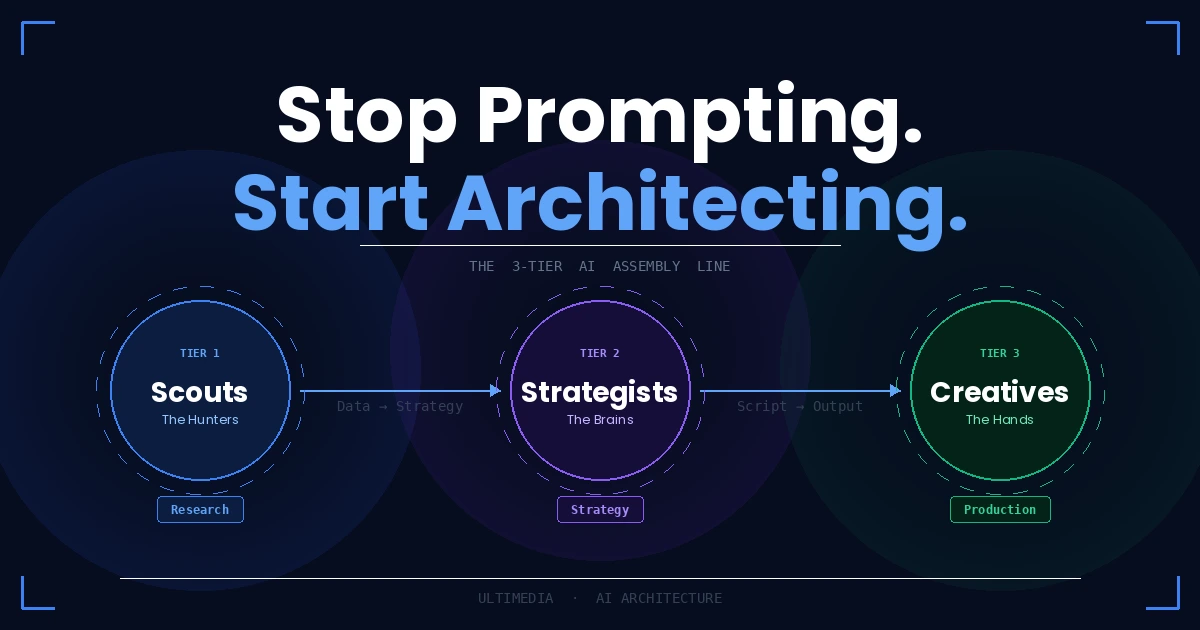
We don’t just “use” technology at UltiMedia; we build departments. It’s an invisible infrastructure-a digital assembly line where the work keeps moving whether we’re at our desks or not. This structured multi-tier ecosystem is what separates elite output from mediocre spam.
The 3-Tier System:
- Tier 1: The Scouts: Their only job is hunting for signals. We use tools like Perplexity AI or Google Gemini to surface high-velocity conversations and raw data.
- Tier 2: The Strategists: This is where context becomes direction. Agents like Claude or ChatGPT-4 take the raw data and build a narrative.
- Tier 3: The Creatives: They handle the “look and feel,” turning scripts into Midjourney images or [suspicious link removed] voiceovers. The thinking is already done; they just execute.
The PTCF Framework: Your Digital Fence
If you want Agentic AI workflows that don’t wander off into HR-speak, you need a syntax. We run everything through the PTCF framework:
- Persona: Give it a personality it can work with (e.g., “Cynical Investigative Journalist”).
- Task: Be specific. Extract data points, don’t just “summarize.”
- Context: Set the limits. Focus on the last 48 hours of JSE updates only.
- Format: Define the output. A 3-second hook, a 30-second analogy, and one CTA.
Why You Are the “Managing Editor”
AI is an excellent intern but a terrible CEO. In our Agentic AI model, the machine does the 80% of grunt work that used to eat your day, but you hold the red pen. You bring the human instinct and the judgment call. You aren’t a creator anymore; you’re the director of a digital workforce.
You are leasing infrastructure instead of trading hours for labor. If you want to understand how seriously this shift is being taken at an institutional level, MIT Sloan Management Review has been writing about the agentic economy for a while now. It’s not a theory anymore; it’s already happening.
Logic Loops and Information Arbitrage
The secret sauce is the transition from passive tools to active agents. If an Agentic AI node hits an error, it doesn’t just stop. It recognizes the failure, adjusts its approach, and retries. This allows your business to run 24/7 without a human needing to click “enter” every five minutes.
We then apply Information Arbitrage. One well-researched piece of “DNA” content is broken down into 30+ assets, from Convert-Kit email sequences to LinkedIn carousels.
The 8-Step Blueprint to Autopilot
- Niche Mining: Hunt for the pain points in Reddit and industry forums.
- The Research Chain: Use Agentic AI to pull stats and cross-reference live data.
- Strategic Formatting: Apply PTCF to turn data into a brief.
- Creative Production: Use specialized stacks for visuals and audio, like Hey-Gen for video avatars.
- Multi-Platform Arbitrage: Shape one input into thirty outputs.
- CRM Integration: Connect outputs to your backend via Zapier or Make.com.
- Aggressive Testing: Launch variations and let the data kill the losers.
- Autonomous Handover: Script the proven workflow into a permanent logic node.
The Bottom Line
The future doesn’t belong to whoever writes the cleverest prompt. The people who win are the ones who own the infrastructure. Gartner’s projections for 2026 point to enterprise AI agents running significant portions of business operations independently.
If you’re still opening a chat window every morning to ask for a social media post, you’re working for the tool. It’s time to flip the switch. Are you still shaking the magic eight-ball, or are you ready to build the machine?