

POPIA AI compliance
Someone in your business pasted a customer list into ChatGPT this week.
Not out of malice. Out of speed. They had a spreadsheet of 400 names, ID numbers and cellphone numbers, a deadline at 4pm, and an AI tool that could clean it in eleven seconds. So they used it. Nobody signed off. Nobody logged it. And nobody in the building can currently tell you which country that data is sitting in right now.
Let’s be honest about what just happened. That was a cross-border transfer of personal information under Section 72 of the Protection of Personal Information Act, and there is a strong chance it was unlawful.
We’ve spent the past two years building AI systems for South African businesses, and this is the pattern we see in nearly every audit. The tooling raced ahead. The governance never left the starting blocks. And the gap between the two is where the risk lives.
The 40-second version
POPIA AI compliance is not a separate law. It is the Protection of Personal Information Act applied to AI tools. Any personal information you feed into an AI system is “processing” under POPIA. If that system operates offshore, Section 72 restricts the transfer. If it makes decisions about people, Section 71 restricts the automation. Fines reach R10 million.
That is the whole thing. Everything below is detail, evidence, and what to actually do about it.
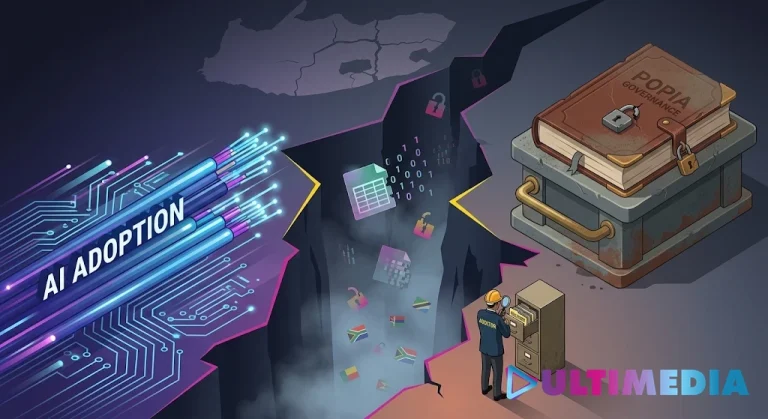
South Africa is adopting AI faster than it is governing it
The numbers are not ambiguous. Microsoft’s AI Economy Institute found that 23.1% of South Africa’s working-age population used an AI product in the first quarter of 2026, up from 21.1% in the second half of 2025. That ranks us 46th out of 147 economies and first on the African continent.
Good news, mostly. We are ahead of the Global South average of 15.4%, though still behind the Global North’s 27.5%.
Now hold that next to the regulatory reality. The Department of Communications and Digital Technologies published South Africa’s draft National AI Policy on 10 April 2026, with comment closing 10 June. Six strategic pillars. Human control over AI as a founding principle. Transparency and explainability. Decisions that stay contestable.
Here is the part that made us sit up. The draft policy does not mention POPIA AI compliance. Not once, according to Fasken’s analysis of the document.
Read that again. The country’s flagship AI policy and the country’s data protection law are currently two ships passing in fog. Guidelines for high-risk AI use cases are pencilled in for the 2026/27 implementation year. Which means for right now, today, in your business, POPIA AI compliance is the only enforceable rule South Africa actually has.
It is also more than sufficient to hurt you.
What POPIA AI Compliance Actually Requires
Two sections carry almost all the weight. Most businesses have read neither.
Section 72: your data has a passport problem
Section 72 says personal information may only leave South Africa under specific conditions. The recipient must be subject to a law, binding corporate rules, or a binding agreement providing an adequate level of protection. Or the data subject consents. Or the transfer is necessary to perform a contract with them.
Now think about the free-tier AI account someone in your sales team signed up for with a personal Gmail address. No data processing agreement. No adequacy assessment. No consent from the 400 people on that spreadsheet. Data now resident in a jurisdiction nobody checked.
That is not a grey area. That is a Section 72 breach with a paper trail.
Special personal information makes it worse. Health records, biometrics, religious beliefs, and children’s data carry heightened protection and simply cannot be shipped to unapproved offshore services. If you run a medical practice, a school, an HR function, or an insurance brokerage, this paragraph is about you specifically.
Section 71: the robot cannot be the final word
Section 71 prohibits a data subject being “subject to a decision which results in legal consequences for him, her or it, or which affects him, her or it to a substantial degree, which is based solely on the basis of the automated processing of personal information.”
Credit decisions. Job application screening. Insurance pricing. Tenant vetting. Debt collection prioritisation. All of it lands here.
You can still automate. But you need two things: an opportunity for the person to make representations, and disclosure of “sufficient information about the underlying logic” of the processing. Which means a black-box model you cannot explain is a legal liability the moment it declines someone’s application.
We wrote about the difference between an agent that decides and an agent that recommends in our piece on the AI agent supervisor pattern. The distinction is not academic. It is the line between compliant and exposed.
The enforcement question: is anyone actually watching?
The honest answer used to be “not really.” That answer has expired.
The Information Regulator fined the Department of Justice and Constitutional Development R5 million on 3 July 2023, after the department ignored an enforcement notice issued that May. The underlying failure was almost mundane: expired software licences, including intrusion detection that would have caught the intruder, and a failure to report a 2021 compromise that lost roughly 1,204 files of personal information.
The Regulator has not slowed down. Its first enforcement notice of 2026, published 20 May, targeted Central Johannesburg TVET College over breaches of Sections 8, 15(1), 19 and 22(1). No monetary penalty this time. Instead: register your Information Officer within 31 days, notify affected data subjects within 31 days, issue a written apology, submit a compliance framework, train your staff within 90 days.
Notice the pattern. The Regulator issues an order. Ignore the order and the fine arrives. The Department of Justice did not get fined for the breach. It got fined for ignoring the notice.
The ceiling is R10 million in administrative fines, with up to 10 years imprisonment for serious offences and personal liability exposure for directors. Ignore POPIA AI compliance and that ceiling becomes the floor of your next board meeting.
The financial argument, with the caveat attached
You will see a figure doing the rounds: R141.96 billion, roughly 1.81% of South African GDP, as the annual economic cost of data breaches. Cube ICT Solutions calculated it by multiplying 3,219 reported breaches in the 2025/26 financial year by IBM’s average breach cost.
We are going to be straight with you, because we would rather be useful than dramatic. That figure applies a global average cost per breach to a South African breach count. It is directionally interesting and methodologically loose. Treat it as a headline, not a forecast.
The IBM data underneath it is firmer, and more relevant to AI specifically. IBM’s 2026 Cost of a Data Breach report put the global average at $4.99 million and found that one in four malicious breaches were AI-enabled, a 56% jump year on year, averaging $6 million each. More than 20% of organisations reported breaches that targeted their AI models or applications directly. The two most common entry points were compromised APIs, applications or plug-ins at 27%, and cloud misconfigurations affecting AI workloads, also at 27%.
Compromised plug-ins and misconfigured cloud AI workloads. In other words: exactly the shadow AI stack your team assembled without telling anyone. None of that shows up on a POPIA AI compliance checklist until it is discovered the hard way.
What compliant AI actually looks like
Here is where most compliance content stops and starts selling fear. We would rather give you the architecture.
Keep the data where the law can see it. The cleanest answer to a Section 72 problem is to never trigger Section 72. A private or local LLM deployment runs the model inside infrastructure you control, on your terms, with your logs. Personal information does not cross a border, does not enter someone else’s training corpus, and does not depend on a vendor’s terms of service staying favourable. For medical, legal, financial and education clients, this stops being a preference and becomes the only defensible option. Our local LLM deployment work exists for precisely this reason.
Put a human at the decision point, not the data-entry point. Automate the gathering, the drafting, the sorting, the summarising. Keep a person on any output that changes someone’s legal position. This is cheaper than it sounds and it satisfies Section 71 without gutting your efficiency gains.
Log the logic. If your system influences a decision about a person, you need to be able to explain how. Not in a whitepaper. In a sentence, to that person, on demand. Design for that from day one because retrofitting explainability into a deployed model is genuinely painful.
Kill the shadow stack. POPIA AI compliance dies quietly in the tools nobody declared. Run an inventory. Every AI tool, every browser extension, every plug-in with API access to your CRM. Most businesses we audit find between six and fifteen tools nobody formally approved.
Get the paperwork in place. Register your Information Officer with the Regulator. Sign data processing agreements with every AI vendor that touches personal information. Do a transfer impact assessment before onboarding anything new. This is boring, and boring is what survives an enforcement notice. Boring paperwork is what POPIA AI compliance actually looks like in practice.
The strategic angle nobody is discussing
There is a competitive point buried in all of this, and it is the reason we think POPIA-aware AI is a business advantage rather than a tax.
Bramley Maetsa of Sasol framed the sovereignty question sharply: can South Africa govern AI responsibly if we do not control the compute, the data centres, and the foundation models it depends on? The University of Cape Town’s MzansiLM project, a foundation model trained across all 11 official languages, suggests the local capability question is not hypothetical anymore.
For your business, translate that down a level. Every enterprise client, every government tender, every large corporate procurement process in this country is going to start asking where your AI processes data. The businesses that already have an answer will win those contracts. The ones improvising will lose them.
POPIA AI compliance is not the cost of using AI. It is the credential that lets you sell it.
Frequently asked questions
Does POPIA apply if the AI tool is free?
Yes. POPIA regulates the processing of personal information, not the commercial terms of the tool. A free tool with weak terms is usually higher risk, not lower, because free tiers frequently reserve the right to use inputs for model training. That is still POPIA AI compliance risk, regardless of price.
What if I anonymise the data first?
Properly de-identified data falls outside POPIA. The catch is that “properly” is a high bar, and re-identification through combined data points is common. Stripping names while leaving ID numbers, addresses and dates of birth is not de-identification.
Do I need consent for every AI use?
No. Consent is one of several lawful bases. Contract performance, legal obligation and legitimate interest can apply. But relying on legitimate interest requires you to have actually documented the balancing test, not just assumed it.
Is a South African cloud region enough?
It helps significantly with Section 72, but check the fine print. Some services process in-region while routing logging, telemetry or support access elsewhere. Ask the vendor for a data flow diagram in writing.
How long does a private LLM deployment take?
For a scoped business use case, typically two to six weeks depending on integration complexity and how clean your data is. The data preparation is almost always the longer half.
Where this leaves you
The regulation is behind the technology. It always is. But POPIA is fifteen years old and enforceable today, and it covers more AI activity than most South African executives realise.
You do not need a legal department. You need an inventory, an architecture decision, and someone who understands both the model and the Act.
That last part is what we do. If you want to know where your AI stack currently sits relative to POPIA AI compliance, talk to us about a private LLM deployment or a governance review of what you are already running. We will tell you the honest answer, including “you are fine, stop worrying” when that happens to be true.
Stop grinding. Start scaling. Just do it in a way that survives an audit for POPIA AI compliance
UltiMedia is a Cape Town-based AI-first agency building automation, private LLM deployments and search visibility systems for South African businesses. Technical leadership by Moegamat Riyaadh Slarmie, whose open-source work is at GitHub.
Sources cited in this article
- Microsoft AI Economy Institute, Global AI Diffusion Q1 2026 report (May 2026)
- Department of Communications and Digital Technologies, Draft South Africa National AI Policy (10 April 2026)
- Fasken, analysis of the Draft National AI Policy (April 2026)
- Bowmans, on the R5 million Information Regulator fine (July 2023)
- Information Regulator enforcement notice, Central Johannesburg TVET College (20 May 2026)
- IBM, Cost of a Data Breach Report 2026 (29 July 2026)
- Cube ICT Solutions breach cost estimate, via Business Report (July 2026)
- Protection of Personal Information Act 4 of 2013, Sections 71 and 72