

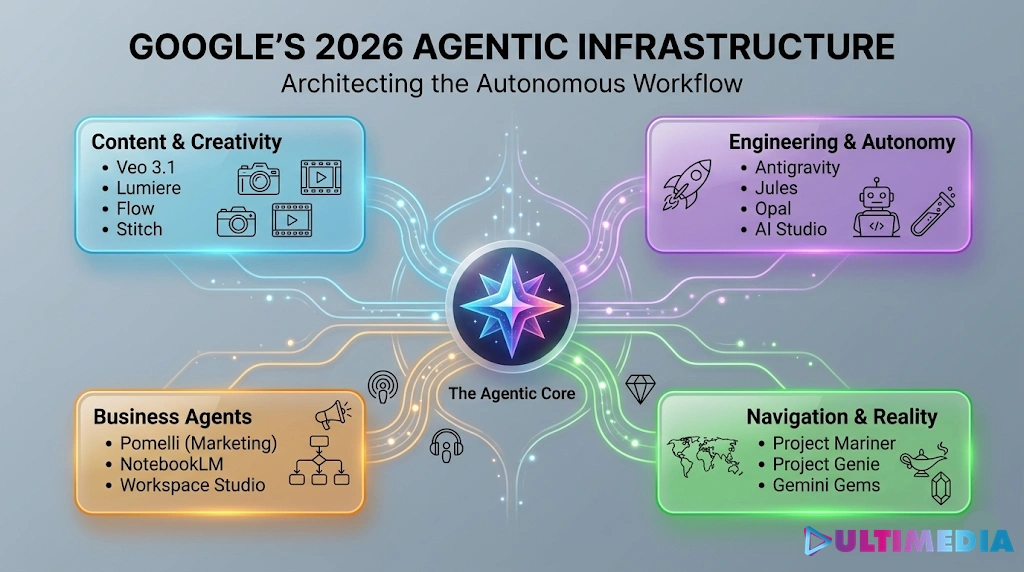
Google’s Agentic Infrastructure
Google’s Agentic Infrastructure is an interconnected network of autonomous AI models and tools designed to execute multi-step business workflows without constant human intervention. In 2026, this system has transitioned from simple “chat” assistants to a fully realized “action” layer where software agents manage entire project lifecycles.
You might have noticed that the conversation around AI has shifted from “How do I write a prompt?” to “How do I build a system?” This isn’t just a change in terminology. It’s a fundamental restructuring of how work happens. At UltiMedia, we’ve observed that companies in Cape Town and globally are no longer looking for creative sparks; they are looking for reliable, autonomous engines.
This movement is what we call the shift to Agentic AI: Stop Prompting Start Architecting in 2026. The map of this new world includes heavy hitters like Google Antigravity, an agentic IDE that doesn’t just suggest code-it writes and optimizes it-and Google Pomelli, an agent specifically tuned for marketing automation.
Why Agentic Workflows Are Now Mandatory for Business
Agentic workflows are sets of coordinated AI agents that autonomously plan, execute, and refine complex business processes across multiple platforms. Unlike traditional bots that follow static rules, these agents use reasoning to adapt to new data, making them essential for maintaining competitive efficiency in 2026.
Think about the traditional marketing funnel. Usually, you need a human to research keywords, another to write the copy, and a third to schedule the posts. In the current Google’s Agentic Infrastructure, tools like Google Pomelli handle the entire campaign cycle.
This is part of a broader trend we’ve covered regarding The Shift To Agentic AI & Autonomous Campaign Optimization, where manual targeting is effectively becoming a thing of the past.
- Autonomy: Agents operate proactively toward a goal, rather than just reacting to prompts.
- Interoperability: The Agent2Agent (A2A) protocol allows different specialized agents to “talk” to each other, passing tasks from one to the next seamlessly.
The Build & Code Revolution: Meet Antigravity and Jules
Google Antigravity is a next-generation Integrated Development Environment (IDE) that utilizes autonomous agents to write, debug, and deploy software code in real-time. It represents the pinnacle of the “Build & Code” quadrant, effectively removing the manual labour of bug fixing and repository management for modern developers.
If you’re managing a technical team, you know that the “vibe coding” era-where we just hoped the AI got it right-is over. Google Jules acts as an asynchronous coding partner. It handles the “boring” stuff: managing pull requests, documenting codebases, and catching security vulnerabilities before they ever reach production.
This isn’t about replacing developers; it’s about giving them a fleet of junior engineers that never sleep. For local South African startups, this is a massive win. You can now build enterprise-grade software with a fraction of the traditional overhead.
Creative Dominance with Veo 3.1 and Flow
Google Veo 3.1 is a high-fidelity video generation model capable of producing 4K cinematic content with natively synchronized audio and realistic physics. This tool, alongside Google Flow, allows creators to maintain character consistency and scene logic across an entire production, bridging the gap between “AI clips” and professional filmmaking.
The level of control here is unprecedented. In the past, AI video felt like a lottery-you never knew if the character’s face would stay the same. Now, with Space-Time Diffusion technology in Lumiere, the motion is fluid and the physics are accurate. Whether you’re creating an Instagram Reel or a high-end commercial, the output is indistinguishable from reality.
Navigating Reality with Project Mariner and Genie
Project Mariner is an autonomous browser agent that can navigate the open web, interact with various interfaces, and complete complex transactions on behalf of the user. It marks the transition from search engines that provide information to agents that provide results, effectively turning the internet into a giant, actionable database.
Imagine needing to book a multi-city business trip with specific budget constraints and airline preferences. Instead of spending two hours on different tabs, you give the goal to Project Mariner.
It’s the ultimate “concierge” experience. For those wondering how this affects your own discovery online, we recently broke down The Brutal Truth About Agentic AI Dominance in 2026 and how search is changing.
The Strategic Shift: Stop Prompting, Start Architecting
The era of the “perfect prompt” is dead because Google’s Agentic Infrastructure has become too smart to need one. Today, the real value lies in being a System Architect. You shouldn’t be focused on how to ask the AI to write a blog post; you should be focused on how to connect your CRM to an agentic loop that handles lead generation, content creation, and customer follow-up automatically.
At UltiMedia, we don’t just “use” AI. We build the architecture that makes it work. To understand the fundamental difference between these future intelligences, check out our guide on ASI and AGI: What Is Artificial Superintelligence & Artificial General Intelligence.
The world is moving toward a future where “work” is something you supervise, not something you do. The agents are ready. The infrastructure is live. The only thing left is to decide is, if you’re going to lead the change or just watch it happen.