

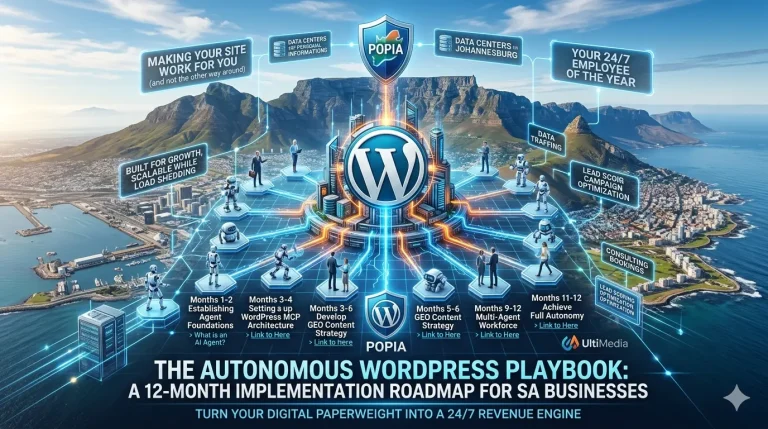
Autonomous WordPress implementation for SA businesses: The 12-Month Ghost-to-Growth 2026 Roadmap: Making WordPress Work.
Let’s be brutally honest for a second: most South African business websites are digital paperweights. You spent a small fortune on a “lekker” design, your brother’s friend’s cousin “optimized” it for SEO, and yet, it sits there-static, silent, and doing absolutely nothing for your bottom line. It’s like having a storefront in the middle of the Karoo with no road leading to it. We’re here to give your site a brain, a heartbeat, and a sales quota.
In 2026, the “build it and they will come” era hasn’t just died; it’s been buried by companies that realized a website should be an employee, not an expense. At UltiMedia, we’ve spent years gutting bloated, useless platforms and replacing them with autonomous digital marketing systems that actually move the needle. This isn’t another generic guide written by a bot that doesn’t know the difference between a “robot” (traffic light) and a “robot” (AI). This is the definitive guide to Autonomous WordPress implementation for SA businesses-a 12-month battle plan designed specifically for the South African landscape.
We’re talking about shifting from a static page to a multi-agent powerhouse that handles everything from lead gen to technical SEO while you’re stuck in a Stage 6 load-shedding block or grabbing a flat white in Sea Point.
Months 1-2: Establishing the AI Agent Foundations
You wouldn’t hire a manager without a job description, yet people throw AI at their business and hope for magic. We’ve noticed the biggest failure point in any Autonomous WordPress implementation for SA businesses is a lack of clarity at the start. Before you touch a single line of code, you need to define what an AI agent actually is for business. And no, it’s not just a chatbot that hallucinates lies about your pricing to annoyed customers on WhatsApp.
An agent is a functional unit of intelligence. It has a goal, a set of tools, and the “agency” to complete tasks. During these first sixty days, we focus on identifying the bottlenecks in your current workflow. Are you manually answering the same five questions? Is your contact form sending leads into a Gmail black hole? We start by building the AI agent foundations to replace the repetitive drains on your sanity.
According to research by Gartner, agentic AI is one of the top strategic trends because it moves from generating content to executing workflows. By effectively turning your site from a brochure into a digital worker that understands the “truth” of your business data, you’re setting the stage for growth that doesn’t require more headcount.
Months 3-4: The WordPress MCP Architecture Setup
Here is where the technical heavy lifting happens. To make WordPress truly autonomous, it needs to talk to your entire tech stack-your CRM, your inventory, and your external databases. This is where a professional WordPress MCP architecture setup comes into play. Think of the Model Context Protocol (MCP) as the universal translator for your business.
We’ve seen too many SA businesses struggle with “siloed” data. Your website doesn’t know what your sales team in Jozi is doing, and your sales team has no clue what the website is promising to a lead in Durban. By setting up a robust Model Context Protocol autonomous architecture, we create a unified nervous system. Now, your site isn’t just displaying information; it’s querying live data to make real-time decisions.
When you implement an Autonomous WordPress implementation for SA businesses, you stop prompting and start architecting. This isn’t about asking an AI to write a blog; it’s about a system that detects a drop in stock, updates the product page, drafts a promotional email, and alerts your sales team-all without you lifting a finger. If you want to see how we handle this technically, check out our deep dive on Agentic AI workflows.
Months 5-6: Dominating through Generative Engine Optimization (GEO) South Africa
If you’re still obsessed with traditional blue-link SEO, you’re already behind. The game has shifted to Generative Engine Optimization (GEO). When someone asks Gemini or Perplexity, “Who is the best AI automation agency in Cape Town?”, you don’t want to be a link on page two-you want to be the answer the AI speaks out loud.
During this phase of your Autonomous WordPress implementation for SA businesses, we pivot your content strategy entirely. We stop writing for bots and start writing for “answer engines.” This means structuring your data using advanced schema and entity-based content so LLMs can digest it effortlessly. We’ve found that businesses focusing on Generative Engine Optimization early see a massive spike in high-intent traffic.
It’s about being the most “citable” brand in your niche. In the local context, this means ensuring your business is recognized as an authority within the South African market specifically. We don’t just want global traffic; we want the person in Sandton looking for a specific solution to be served your content as the primary recommendation.
Months 7-8: Autonomous Campaign & Lead Scoring
By month seven, your foundation is solid. Now we turn on the engines of autonomous digital marketing. We implement autonomous campaign optimization that doesn’t just “post for the sake of posting.” These agents monitor market trends, look at what your competitors are missing, and fill the gap with high-value insights.
But traffic is vanity; conversions are sanity. A successful Autonomous WordPress implementation for SA businesses integrates autonomous lead scoring that vets every person who interacts with your site. Instead of a “Contact Us” form that requires a manual reply three days later (by which time the lead is gone), an agent engages the prospect instantly. It asks the qualifying questions, checks their budget, and only drops a booking in your calendar when they are “ready to buy.”
This is a ruthless filter. It ensures you only spend time on deals that actually close. For a detailed look at how to refine your visibility during this phase, our guide on SEO agency strategies in Cape Town breaks down the local nuances of search intent.
Months 9-12: Scaling the Multi-Agent Workforce
The final stretch of the Autonomous WordPress implementation for SA businesses is about orchestration. You’ve moved from one or two “helper” bots to a full-blown digital workforce. At this stage, your WordPress site is managing its own updates, optimizing its own performance based on user behavior, and even suggesting new product lines based on search data it has collected locally.
We’ve noticed that this is when the “compounding effect” kicks in. Your cost per lead plummets because your system is self-optimizing. You aren’t paying a massive team to move pixels or manually upload CSVs; you’re paying a lean strategy team to steer the ship while the autonomous agents do the rowing.
At this stage, you are no longer just a business with a website. You are an AI-first operation. Your Autonomous WordPress implementation has become your most valuable asset, working 24/7/365 without needing a lunch break or a performance review. You are now positioned to outpace any competitor still stuck in the manual era.
The Reality Check: Why This Matters Now
Let’s talk straight: “digital transformation” is a tired buzzword used by consultants to sell expensive slide decks. We don’t do slides. We build systems that work while you sleep. The gap between the companies that automate and those that don’t is becoming a canyon. If you stay on the wrong side of it, no amount of traditional marketing is going to save you.
South African businesses face unique challenges-from infrastructure instability to a highly competitive local market. An Autonomous WordPress implementation for SA businesses isn’t just a “nice-to-have” anymore. It’s your insurance policy against obsolescence. When your competitors are manually struggling with their WordPress plugins and trying to figure out why their traffic is dropping, your autonomous agents are already three steps ahead, adjusting your strategy in real-time.
Stop playing safe. In 2026, a “dumb” website isn’t just a missed opportunity; it’s a liability. You’re paying for hosting, you’re paying for a domain, and you’re paying for maintenance-you might as well have a system that pays you back.
Conclusion: Making WordPress Work for You
The 12-month roadmap isn’t a sprint; it’s a strategic build. But once that machine is running, it’s a “jol” to watch it work. You move from the frustration of a “ghost” site to the thrill of a growth engine.
Whether you’re a boutique agency in the Southern Suburbs or a manufacturing giant in Epping, the principles of Autonomous WordPress implementation for SA businesses remain the same:
- Build the right AI foundations.
- Architect a unified nervous system with MCP.
- Dominate the “answer engines” via GEO.
- Filter for high-quality leads autonomously.
- Scale your digital workforce to handle the heavy lifting.
If you’re ready to stop being a ghost and start seeing real growth, it’s time to look at your site differently. This isn’t just about code; it’s about business survival. Think your industry is too “old school” for this? We’ve yet to find a business that doesn’t run better with a brain.
Challenge us in the comments-tell us what you do, and we’ll tell you how an Autonomous WordPress implementation could change your game. Or, if you’re ready to skip the talk and get to work, check out our full range of AI automation services and let’s get your site on a sales quota.