

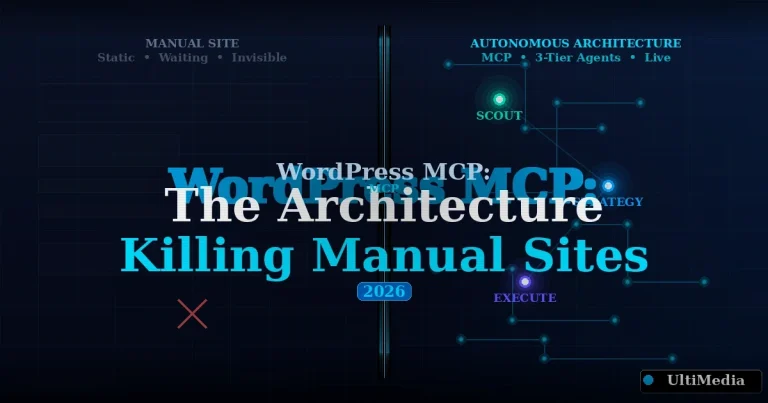
WordPress MCP: The Architecture Quietly Killing Manual Sites
The protocol turning South African WordPress sites into self-managing machines is already live – and the businesses running it aren’t talking. Here’s what they know that you don’t.
WordPress Autonomous Architecture: What the WordPress MCP Protocol Actually Does.
WordPress autonomous architecture isn’t a plugin. It isn’t a smarter chatbot, and it’s definitely not the scheduled-post “automation” your agency keeps calling AI. It’s a live, bidirectional operating layer – and the tool making it real in 2026 is called the Model Context Protocol (MCP).
Here’s the short version. The MCP specification, published by Anthropic in late 2024, gives AI agents a standardised way to connect directly to external systems. Your full WordPress environment, specifically. That means an agent can read your content, rewrite your metadata, publish posts, update your WooCommerce product listings, and respond to live traffic signals – without a human touching a thing.
Most South African agencies haven’t heard of it. The ones who have aren’t advertising the advantage.
Your Site Has a Body. MCP Gives It a Brain.
Let’s be honest. The average WordPress site in 2026 is a very expensive digital brochure. Static. Reactive. Sitting there, waiting for someone to log in with a coffee and a grudging to-do list.
We’ve built enough of these to know how the cycle runs. You update something – traffic ticks up. You get busy and don’t update it – traffic drifts. You remember to check Google Search Console on a Thursday, panic slightly, update something, repeat. The whole operation runs on human memory, human bandwidth, and whoever happened to notice the numbers slipping.
An autonomous WordPress architecture doesn’t run that way. It watches the site the way a sharp operations manager watches a factory floor – continuously, specifically, and without needing a weekend.
Why This Isn’t the Same Thing as “Automation”
We need to be precise here, because “automation” has been so thoroughly abused by marketing agencies that the word barely means anything anymore.
Scheduled posts? Automation. A chatbot running off a decision tree? Automation. An abandoned cart email triggered by WooCommerce? Still just automation.
WordPress autonomous architecture powered by MCP is something categorically different. Picture an agent reading your live analytics, identifying a product page with a 68% exit rate, diagnosing that the H1 is misaligned with current search intent, rewriting the copy, updating the meta description, and publishing the fix. Without you being looped in at any point.
That’s not automation. That’s a system with genuine agency. And what an AI agent actually is – the ability to think, decide, and act without babysitting – changes the operational maths of running a WordPress site entirely.
The 3-Tier Architecture: How We Actually Build This
We broke down the foundational philosophy in Stop Prompting, Start Architecting. Here’s exactly how our 3-Tier Assembly Line maps to a functioning WordPress autonomous architecture – not the theory version, the one we actually deploy.
Tier 1 – Scout Agents: The Signal Hunters
These agents run continuous monitoring loops. They don’t produce content. They don’t touch the site directly. Their only job is to find what’s slipping, what’s gaining, and what needs attention – then pass a structured briefing upstream.
They’re watching:
- Your live keyword positions (daily, not weekly – weekly is already too late)
- Competitor content movements in your category
- Page-level traffic patterns and exit signals inside WordPress itself
- Search intent shifts relevant to GEO – because what people are looking for changes faster than most editorial calendars can track
One scout agent, running around the clock, will catch things a human notices maybe once a month.
Tier 2 – Strategy Agents: The Decision Layer
Raw signal becomes action plan here. Strategy agents don’t touch your site – they’re architects, not builders. They look at what the scouts flagged and decide what needs fixing first, what needs A/B testing, and what’s serious enough to escalate to a human.
Every instruction they produce runs through the PTCF framework – Persona, Task, Context, Format. That’s what keeps an autonomous system from going off-script and pushing changes your brand voice would never sanction. (It happens. We’ve seen the results. Not pretty.)
Tier 3 – Execution Agents: The MCP Layer
This is where the WordPress MCP protocol becomes the actual edge. Execution agents take the strategy tier’s instructions and carry them out – directly inside WordPress, via the protocol’s live read/write connection.
They update posts. Refresh metadata. Fix structural issues. Publish new content. Push WooCommerce product copy. All against your live site, in real time, with a full audit log. Using LangGraph or CrewAI as the orchestration backbone, the agents coordinate without collision.
The human role in all of this? Review the log. Authorise escalations. Set the direction. That’s it.
Most agencies are running a single-tier operation dressed up as agentic AI. The gap between that and a functioning 3-tier autonomous WordPress architecture is not subtle.
The POPIA Clause Nobody in This Space Wants to Address
Here’s the section every overseas WordPress AI guide skips – because it doesn’t apply to them. It absolutely applies to you, operating in South Africa.
Section 71 of the POPIA Act regulates automated decision-making directly. If your WordPress autonomous architecture is personalising content by user profile, adjusting pricing dynamically, or filtering products based on browsing behaviour – you’re inside the scope of Section 71. You need a human-in-the-loop checkpoint and a documented audit trail. Not as a nice-to-have. As a legal requirement.
South Africa’s draft AI Policy framework, open for public comment until June 2026, doubles down on this – requiring explainability, accountability, and data protection by design for high-risk automated systems.
At UltiMedia, we don’t bolt compliance on after the fact. We wire it into the architecture from the first day:
- Full decision logging. Every agent action touching customer-facing content gets a timestamp and the exact data signal that triggered it. If a regulator ever asks why your site served a particular offer to a particular user segment, you point to the record.
- Data minimisation at instruction level. Agents are scoped to collect only what their specific task requires. Nothing extra gets pulled, stored, or moved.
- Human authorisation gates on high-risk actions. Anything involving pricing, credit, or granular user profiling requires sign-off before execution. The agent recommends. The human authorises.
Build this layer first. Everything else runs cleanly on top of it.
How WordPress Autonomous Architecture Feeds Your GEO Citations
This is the angle most businesses haven’t connected yet – and it might be the most commercially important piece in this entire post.
Generative Engine Optimisation is the discipline of building content that AI models – Google AI Mode, ChatGPT Search, Perplexity – actively choose to cite as sources. These models don’t rank by keyword density. They reference specific, verifiable facts. Named frameworks. Identifiable methodology. Real statistics with a source attached.
Vague content doesn’t get cited. It gets passed over entirely.
Here’s where the MCP connection becomes a citation machine. Scout agents identify where your published posts have gone factually stale – a statistic from 18 months ago, a claim that a newer study contradicts. Strategy agents flag the specific sections needing updates and identify credible fresh sources. Execution agents push the updated content live via MCP, immediately.
The citation flywheel runs itself. Fresh facts. Live site. Continuous improvement. The businesses not running this loop are publishing outdated content and wondering why Perplexity keeps citing their competitors instead of them. The answer isn’t a mystery – it’s a maintenance gap that an autonomous WordPress architecture closes automatically.
The Ad-to-Landing-Page Gap Nobody Is Closing
We’ve watched this kill campaigns that had everything else right. The autonomous campaign optimisation layer is running – bids adjusting, creative rotating, budget reallocating toward margin-positive products. The numbers look solid.
Then someone clicks the ad. Lands on a page that hasn’t been updated since the campaign brief was written three months ago. Hesitates. Leaves.
Closing that gap manually – syncing messaging between live ad creative and live landing pages, in real time, at any meaningful scale – is basically impossible. It requires more coordination between more people than most teams have.
MCP closes it. When campaign intelligence agents and WordPress execution agents share the same live data layer, a page seeing elevated bounce traffic from a specific ad creative gets flagged, diagnosed, and updated – before the campaign budget bleeds further into it.
That closed loop doesn’t exist in a standard WordPress setup. It’s what autonomous digital marketing actually looks like when it’s running properly – as opposed to how it looks on a vendor’s slide deck.
What the Honest Caveat Looks Like
We’d be doing you a disservice if we didn’t say this clearly.
If your current content is thin, your WordPress structure is a mess, and your brand guidelines exist primarily in someone’s head (you know exactly who we mean), connecting MCP to that environment won’t help. It’ll execute your mess faster and more thoroughly. That’s not a win.
The sequence that actually works:
- Audit the manual processes eating your team’s time – these are your first agent candidates
- Define what each tier is authorised to do, and what it escalates for human review
- Build your context library: brand voice, product catalogue, audience segments, compliance scope
- Apply the PTCF framework to every agent instruction set before a single one goes live
- Then connect MCP to the structured system
When you wire the MCP layer to a clean, well-defined autonomous WordPress architecture – built the way we describe in What Is an AI Agent for Business? – the compounding starts almost immediately. When you wire it to chaos, you get faster chaos. And faster chaos has a way of becoming very public very quickly.
Why South African Businesses Have a Window Here
South Africa has always had the capacity to leapfrog – skip the intermediate step, go straight to the mature infrastructure. Gartner’s 2026 projections have enterprise AI agents running significant portions of standard business operations independently by year-end. The businesses positioned to capture that aren’t scrambling to retrofit – they built while it was still an advantage.
South African operations aren’t slowed down by the bloated legacy tech stacks crippling large enterprises in the US and Europe. Small team. Lean operation. Right infrastructure. That’s a genuine edge – for as long as it remains one.
The digital workers running inside a mature autonomous WordPress architecture don’t forget to update the pricing page. They don’t miss the competitor content shift on a Friday afternoon. They don’t take the December break and come back to a site that’s been quietly losing ground for three weeks.
You, on the other hand? You notice it when the traffic numbers show it. Usually a month later.
Here’s the Real Talk
The “AI and WordPress” conversation in South Africa is still largely stuck at chatbots and post schedulers. That’s perfectly fine – for everyone who’s satisfied with where they are.
The businesses treating MCP as live operational infrastructure right now aren’t debating whether it works. They’ve seen it work. The gap between a site running a functioning WordPress autonomous architecture and a site running on manual effort and good intentions is widening – not closing.
Your site is either alive: watching itself, correcting itself, updating itself based on what’s actually happening in your market. Or it’s a billboard. A static, expensive billboard that requires a human to keep it current, and immediately loses relevance the moment that human has other priorities.
There’s no profitable middle ground between those two things anymore.
So – do you think your industry is the exception? The one category where the manual approach still holds? Make that case in the comments. We’ve heard most of the arguments. We haven’t found one that holds up past about the third question.