

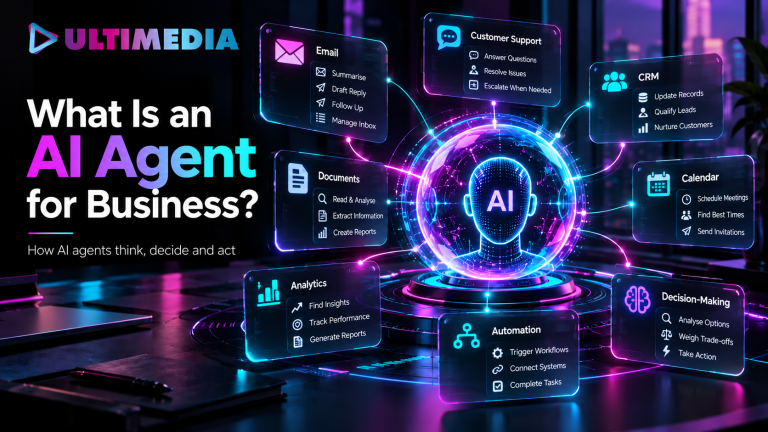
Let’s strip away the hype. An AI agent isn’t a magical digital employee. It is software that can interpret a goal, choose steps, and use approved tools to perform business tasks. Its value depends on reliability, cost, security, and measurable results.
Before You Trust an AI Agent With Your Business, Watch This
An AI agent could update your CRM, handle enquiries and coordinate real work. But what happens when it gets something wrong? Watch UltiMedia’s AI Agent for Business: The Powerful Truth Nobody Tells You explainer series to discover what the 2026 evidence really says.
Watch the full AI Agents Explained | Business Automation & Agentic AI series on YouTube
What Is an AI Agent for Business?
An AI agent for business is a software system that uses artificial intelligence to pursue a goal, examine relevant information, select actions, and work across authorised tools. Unlike a basic chatbot, it may handle several connected steps and check their outcomes. Its permissions and human approval rules define what it can safely do.
How Does an AI Agent Work?
An AI agent for business combines a goal, business context, an AI model, permitted tools, execution steps, and safeguards. It gathers information, considers what to do, performs an authorised action, and checks the result. A simple automation follows a predefined path; an agent can select different steps as the context changes. More autonomy is not always better.
AI Agents vs Chatbots and Automation
A chatbot primarily responds to requests. Traditional automation follows preconfigured rules. An AI agent for business adds contextual choices when a task needs them. An agent may select tools and make contextual decisions within set boundaries. All three can integrate with business software. None automatically improves with every task: learning requires an intentionally designed feedback or training process.
What Does the 2026 Research Say?
Adoption is increasing, but unevenly
McKinsey’s August 2026 State of AI survey reported that 40% of respondents in organisations earning at least $1 billion annually were scaling AI agents, compared with 22% in smaller organisations. These are survey findings, not guaranteed business outcomes. Source: McKinsey.
Reliability is a serious obstacle
LangChain’s June 2026 survey of over 1,300 professionals reported 57% with agents in production and 32% identifying quality as a leading barrier. The sample represents surveyed professionals, not all companies worldwide. Source: LangChain.
Not every agent project succeeds
Gartner warned in October 2026 that over 40% of agentic AI projects could be cancelled by the end of 2027 amid rising costs, unclear value, and inadequate risk controls. This is a forecast, not a measured failure rate. Source: Gartner.
What Can an AI Agent Do for a Business?
Customer service
For customer support, an AI agent for business can route incoming questions, look up approved information, prepare answers, create support tickets, and escalate difficult cases. An agent should not invent a company policy or promise unauthorised refunds.
Sales and CRM
In sales, an AI agent for business can qualify incoming enquiries, prepare follow-ups, update records, and organise pipeline information. Outbound electronic marketing must follow applicable consent and privacy rules.
Operations and finance
For internal operations, an AI agent for business can summarise documents, flag anomalies, coordinate schedules, and prepare financial reports. Sensitive account changes, payments, and binding decisions need suitable approval steps.
Marketing and WordPress
In marketing, an AI agent for business can help analyse campaign results, identify broken links, draft content, and support website administration. Restrict publishing rights and review sensitive updates. Explore our WordPress MCP architecture article.
Security and POPIA: Where Human Oversight Matters
OWASP’s 2026 agentic security guidance highlights the risks of unsafe instructions, excessive permissions, tool misuse, and poor oversight. Apply least-privilege access, log actions, test failures, and require approval for irreversible decisions. Source: OWASP.
In South Africa, the Protection of Personal Information Act remains relevant when agents handle customer information. Section 69 governs certain electronic direct marketing; Section 71 restricts particular solely automated decisions with legal or similarly substantial consequences, subject to statutory exceptions and safeguards. Read our POPIA and AI discussion.
What Does a Custom AI Agent Cost?
Consider process analysis, development, integrations, model usage, licences, hosting, testing, monitoring, and maintenance. UltiMedia’s custom AI development and integration rate is R475 per hour, subject to confirmation in a project quotation. Third-party operating costs may be additional. A fixed workflow can be cheaper than a fully agentic implementation.
How to Start: A Five-Step Plan
- Identify one repetitive bottleneck and measure its current cost.
- Map the workflow, data sources, permissions, and exceptions.
- Choose ordinary automation where it is sufficient; add agent reasoning only when useful.
- Pilot with limited permissions, human approval, logging, and evaluation.
- Measure actual time saved, error rate, operating cost, and revenue contribution before expanding.
Estimate net monthly benefit as measurable labour savings plus incremental gross contribution, minus recurring operating costs. Factor implementation expense into payback calculations.
Frequently Asked Questions
Do AI agents learn automatically?
No. Improvement requires deliberately configured feedback, evaluations, training, or updates. An agent can also repeat mistakes.
Can agents work without people?
Some can complete narrowly authorised tasks with limited intervention. Human oversight remains essential for consequential decisions, unusual exceptions, and sensitive data.
Can a small business afford an AI agent?
Possibly. Costs depend on the complexity of the task, integrations, software use, and ongoing supervision. Start with a small measurable pilot.
Will AI agents replace employees?
They may automate parts of jobs, but workforce effects vary. A software agent is not automatically a substitute for an entire role.
The Bottom Line
AI agents can be powerful when the task is clear, the tools are trustworthy, permissions are limited, and the results are measured. We favour controlled autonomy over expensive demonstrations. Learn about UltiMedia’s AI Automation services or see why an AI agent supervisor matters.