

An AI marketing operating system connects research, paid media, content production, analytics, conversion optimisation and customer follow-up into one accountable workflow. For South African agencies, the objective is not to let an AI agent spend client budgets without supervision. It is to make better decisions faster, with reliable evidence, measurable outcomes and clear approval gates.
This 2026 implementation guide shows how to build an AI marketing operating system around Meta Advantage+, Google Performance Max, GA4, CRM data, n8n and a practical measurement framework. You will find seven actionable practices, a sample workflow, an illustrative rand calculation, a 90-day plan and a production-readiness checklist. Unlike UltiMedia’s existing autonomous campaign optimisation analysis, this article concentrates on how the different systems connect and how their outputs are verified.
Quick answer: Start with one business outcome and a reliable conversion definition. Connect campaign identifiers, analytics events and CRM sales outcomes. Use AI to assist research, draft creative variants and summarise data, but require human approval for spend changes, publication and outbound communications. Judge the system by qualified customers and contribution margin—not just clicks or the number of adverts created.
What is an AI marketing operating system?
An AI marketing operating system is a repeatable operating model combining people, software, source data, decision rules, AI-assisted tasks and governance. It is not a single application, a ChatGPT prompt library or a guarantee of autonomous growth.
Think of it as six connected layers: strategy and market evidence; measurement and attribution; traffic and creative production; conversion optimisation; customer lifecycle operations; and security, approvals and financial oversight. Each layer has a data owner, acceptance criteria and a recoverable failure path.
The essential flow is: research and first-party evidence → approved brief → approved creative → advertising and organic distribution → tagged visit → validated conversion → CRM outcome → reconciled cost and margin report → next human-reviewed decision.
A trustworthy AI marketing operating system also records what was not known. A lead may appear twice across platforms, an order may later be refunded, and offline sales might not be attributed immediately. Uncertainty must survive into reporting instead of being rewritten as certainty by a language model.
1. Establish trustworthy marketing data before automating decisions
The first practice in an AI marketing operating system is to define success before choosing tools. Create a data dictionary specifying what counts as a visitor, enquiry, qualified lead, appointment, paying customer, refund and retained account. Name the system of record and owner of each event.
| Question | Evidence to retain | Accountable owner |
|---|---|---|
| Where did the enquiry originate? | Consistent UTM parameters, landing-page and form records | Marketing operations |
| Was the lead qualified? | Time-stamped CRM status and clear qualification criteria | Sales lead |
| Did the enquiry become revenue? | Invoice, transaction or signed-contract record | Sales and finance |
| What did acquisition actually cost? | Media spend plus clearly stated attributable costs | Media buyer and finance |
| Did the campaign create economic value? | Contribution margin, refunds and retention evidence | Business owner |
Define your metrics precisely. Cost per lead (CPL) equals ad spend divided by leads. Customer acquisition cost (CAC) equals the attributable acquisition costs divided by acquired customers. Return on ad spend (ROAS) is attributed revenue divided by ad spend. None of these formulas alone establishes profit.
Illustrative South African example: when a low CPL hides the real cost
The following numbers are hypothetical teaching figures, not UltiMedia client results. A campaign spends R12,000, produces 100 leads and closes five customers. Its ad-only CPL is R120, while ad-only CAC is R2,400. If each sale yields R4,000 in contribution margin before advertising, five sales create R20,000 of contribution. Subtracting R12,000 in media costs leaves R8,000 before any uncounted agency fees, sales salaries, tools, taxes or overhead. That remaining contribution is not the company’s net profit.
Use the AI marketing operating system to reconcile duplicate enquiries, lagging CRM conversions, cancelled transactions and missing offline outcomes before automating a recommendation. Predictive LTV may be inappropriate when sample sizes are small, customer histories are incomplete or models cannot be validated.
2. Coordinate Meta Advantage+ and Google Performance Max without surrendering controls
Platform AI is most useful when the agency supplies accurate conversion goals, distinct creative, usable product feeds, sensible budgets and legitimate first-party signals. Automated bidding and audience expansion do not remove the need for strategy or oversight.
Meta Advantage+: build varied hypotheses, not 50 cosmetic duplicates
Prepare a controlled creative brief with the customer’s problem, offer, evidence, permitted claims, prohibited claims, brand voice and conversion event. Develop distinct approaches—demonstration, objection handling, comparison, value explanation and customer education. Produce multiple formats only when each adds something meaningful.
Avoid claiming Meta universally requires 150 combinations or that all manual audience settings have disappeared. Available Advantage+ settings, control types and creative limits vary across campaign objectives and account experiences. Review budgets, locations, exclusions, consent and actual qualified-sale outcomes before changing spend.
Performance Max: give Google verified assets and conversion values
Google Performance Max uses machine learning to serve campaigns across eligible Google advertising inventory. Audience signals can help guide the system but are not hard restrictions on delivery. For retailers, feed health, product availability, conversion-value quality and profit-aware segmentation matter as much as creative quantity.
Google’s Performance Max asset guidance supports up to 15 standard headlines (maximum 30 characters each), five long headlines (maximum 90 characters each) and five descriptions (maximum 90 characters each); minimum requirements vary. Supply relevant square and landscape images and original video where suitable, then validate the latest requirements in the active Google Ads interface.
Do not conflate AI Max for Search, the Performance Max campaign type, and Meridian marketing-mix modelling. They serve different purposes. The AI marketing operating system can use evidence from all three where appropriate, but it should not portray them as a single product.
3. Build an approved AI creative pipeline with measurable hypotheses
The creative-production layer of an AI marketing operating system should make research traceable and output reviewable. Faster asset generation is valuable only if the advertising claims are accurate and the resulting variants can be tested fairly.
- Collect permissible evidence. Use owned campaign performance, approved interviews, product documents and legitimately accessible public competitor materials. Do not assume a scraping tool gives you permission to copy personal information or private content.
- Write a structured brief. Record offer, audience question, evidence sources, desired action, platform requirements and brand restrictions.
- Generate distinct hypotheses. Ask the LLM for angles, copy, a visual brief and the specific assumption being tested; avoid unverified claims of performance.
- Verify. Check facts, consent, testimonials, landing-page consistency, character limits and accessibility before any upload.
- Approve and version. Store the approved variant, reviewer, date, campaign ID and creative hypothesis.
- Measure actual outcomes. Compare qualified leads, sales, revenue and costs. Remove winners-and-losers language where differences are statistically or operationally uncertain.
Generating 50 candidate angles does not mean an agency should launch 50 paid variations simultaneously. Choose test volume according to budget, event volume and the ability to distinguish meaningful results.
Practical deliverable: keep a simple table containing the source insight, angle, copy, asset URL, claim-proof link, reviewer, approval status, campaign identifier and result. That record makes the creative process auditable across staff and contractors.
4. Use n8n as the orchestration layer—not an unchecked decision maker
For UltiMedia’s technology stack, n8n can connect campaign, analytics and CRM systems without making a language model responsible for every business rule. A dependable AI marketing operating system places deterministic validation and permission checks around AI-generated summaries.
- Trigger: a scheduled review or authenticated webhook identifying a specific campaign and reporting period.
- Ingest: pull permitted spend, conversion and CRM data with least-privilege API credentials.
- Validate: check schema, currency, reporting window, duplicates, consent status, record ownership and data freshness.
- Calculate: compute CPL, CAC, ROAS and agreed contribution measures in deterministic code—not in an LLM narrative.
- Explain: use AI to draft a plain-language report with linked source records, assumptions and missing-data warnings.
- Approve: send proposed changes to an accountable person; separate approval for sends, publishing, customer-data changes and paid-budget changes.
- Deliver: save or send only approved outputs to authorised channels.
- Recover: record idempotency keys, destination receipts, retry decisions and exceptions so a timeout does not trigger duplicate customer messages or spending actions.
Before a live rollout, deliberately test a revoked token, late API response, duplicated webhook, missing CRM outcome and an unapproved recommendation. See UltiMedia’s n8n workflow recovery guide for the detailed recovery approach.
Human approval is not a performance weakness: it defines which actions the system is authorised to take. You can begin with read-only reporting, establish reliability and only then consider narrowly permissioned write actions.
5. Connect advertising to conversion optimisation and accountable sales follow-up
A strong AI marketing operating system should show what happens after a click. Efficient targeting cannot compensate for an unclear offer, a slow mobile form, misleading landing-page copy or unowned enquiries. Analyse each of these failure points separately.
Prioritise mobile speed and accessibility, message match, qualified conversion definitions, transparent value propositions, form completion and a clear handoff to an accountable person. Ask AI to suggest CRO hypotheses, but treat them as hypotheses. Evaluate variants against sufficient data and genuine business outcomes.
The sales handoff must record owner, due time, approved follow-up channel, consent basis and escalation route. A Facebook lead form is not blanket permission for unlimited emails or messages. Read the existing AI CRO audit for South Africa and lead follow-up automation guide for these specialised topics rather than duplicating their explanations here.
Keep commercial reporting consistent: a lead is not a customer, a scheduled meeting is not a closed sale and attributed revenue is not net profit. The AI marketing operating system should preserve those distinctions in every dashboard and client report.
6. Treat SEO, AEO, GEO and video as interconnected discovery channels
Organic search, answer engines, AI-driven discovery and YouTube should be part of the same measurement conversation—not competing keyword-stuffed content factories. An AI marketing operating system maps each customer question to a distinct intent, the best existing content asset and a relevant next action.
For useful, accessible content, provide a concise direct answer, logical H2/H3 hierarchy, trustworthy evidence, original examples, relevant internal links, up-to-date platform information and descriptive media. AEO and GEO techniques do not override basic SEO: crawlability, helpfulness and original experience still matter. Structured data helps describe a page but does not guarantee ranking, rich results or AI citations.
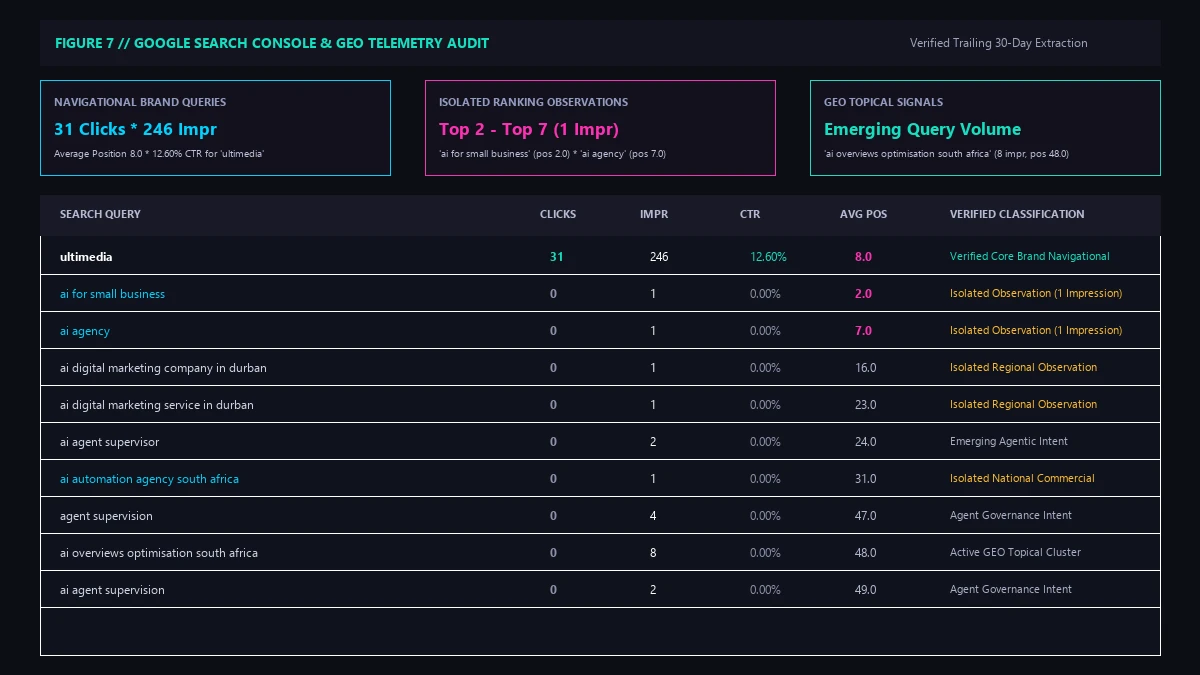
This existing UltiMedia illustration is supplementary; it is not proof that the hypothetical campaign figures above were achieved. More detailed resources already cover generative engine optimisation and AI visibility audits.
Watch the AI marketing operating system explainer above for a walkthrough of how these channels fit into the wider campaign and measurement workflow.
7. Put POPIA safeguards, approvals and financial checks into production
The last practice is governance. For South African businesses, marketing data flows need documented purposes, limited collection, suitable access controls and compliant electronic direct-marketing practices. POPIA Section 69 regulates direct marketing by unsolicited electronic communications, including requirements around consent and the qualifying existing-customer exception. Consult the Information Regulator and seek qualified legal guidance when implementing sensitive campaigns.
The AI marketing operating system should require explicit permission checks, suppression and unsubscribe handling, recipient verification, logging and safe failure behaviour before automated sends. A model can draft a message; an approved workflow should decide whether a particular message may legally and appropriately be sent.
Production-readiness checklist for an AI marketing operating system
- Business outcome: one accountable goal, commercial baseline, approval owner and measurement window.
- Data lineage: documented identifiers, CRM-stage definitions, attribution limitations and source freshness checks.
- Creative validity: claims substantiated, correct brand voice, platform limits checked and accessible images.
- Privacy: documented collection purpose, consent or applicable lawful basis, access restrictions and opt-out process.
- Permissions: read-only by default, explicit budget ceilings and separate approvals for write actions.
- Reliability: timeouts, duplicate events, idempotent retries, audit logs and tested recovery owners.
- Commercial measurement: qualified customers, cancellations, returns, margin and reporting uncertainty.
- Quality assurance: mobile form completion, accessibility, tracking tags, canonical URL and visible fact-checking.
A practical 30/60/90-day implementation roadmap
An AI marketing operating system can be introduced in stages without promising immediate full autonomy.
| Period | Workstream | Acceptance test |
|---|---|---|
| Days 1–30 | Audit campaign UTMs, GA4, CRM stages, lead permission records and cost definitions. | Sampled enquiries and orders reconcile to source systems. |
| Days 31–60 | Introduce versioned briefs, approval rules and read-only n8n reporting. | Each report links to source evidence; no unapproved sending or spending. |
| Days 61–90 | Run controlled creative and landing-page tests; expand approved lifecycle automations. | Review customer quality, attribution, contribution margin, review time and error rates. |
Timelines depend on data readiness, transaction volume, integration permissions and staff capacity. The aim is a stable operating practice—not an arbitrary promise to automate the entire agency by day 90. For a broader cost model, use UltiMedia’s 30-day AI automation ROI playbook.
Frequently asked questions about an AI marketing operating system
Is an AI marketing operating system the same as marketing automation?
No. Automation performs a task or sequence. An AI marketing operating system adds strategy, accountable ownership, shared data definitions, financial measurement and human approval rules across those tasks.
Can AI manage Meta and Google Ads budgets on its own?
Ad platforms automate delivery and bidding, but granting a third-party agent independent spending authority is a separate decision. Set limits, monitor results and require a named owner to approve material changes.
Which metrics matter most for a South African marketing agency?
Report spend, traffic, qualified enquiries, acquired customers, attributable revenue, contribution margin, refunds and measurement uncertainty. CPL or ROAS alone can conceal low-quality leads and unprofitable sales.
Do I need expensive enterprise tools?
No. Begin with verified tracking, the ad platforms you already use, your CRM, approved reporting and n8n. The most expensive mistake is automating unreliable data or an unclear business process.
What is the correct way to review AI-generated adverts?
Validate facts, product eligibility, claims, policies, intellectual-property rights, accessibility, landing-page alignment and a recorded reviewer approval. Do not invent results or testimonials.
How does this approach support SEO, AEO, GEO and AIO?
It creates distinct, useful assets matched to user intent, with evidence and structured content that people and search systems can understand. It avoids producing overlapping articles solely to repeat a keyword. AI citations and rankings are never guaranteed.
Build a reliable system—not simply more content
The real value of an AI marketing operating system is the ability to connect evidence to better business decisions while retaining control of cost, customer relationships and brand trust. Start with one bottleneck and a measurable baseline, test the workflow safely and expand when outcomes support the investment.
Want to connect campaign reporting, CRM data and safe AI workflows? Contact UltiMedia about your marketing and automation architecture. For structured learning, explore Reddy AI, where the six-module AI-Driven Marketer Tutor LMS course has already been created.
Sources, editorial notes and further reading
- Google Ads: Performance Max asset checklist — current creative format limits and recommendations.
- Google Ads: Build a Performance Max asset group — asset-group creation and campaign inputs.
- Google Search Central: Creating helpful, reliable, people-first content — original editorial value.
- Google Search Central: Article structured data — supported publisher and article properties.
- South African Information Regulator — official regulatory material.
Editorial methodology (15 November 2026): This guide draws on six internal NotebookLM sources in the AI-Driven Marketer research notebook and separately checks material platform claims against primary documentation. Numerical business examples are explicitly hypothetical; the additional Engaged Learning Academy advertising and email conversion claims in an internal source were not used as verified client results.