

AI Search South Africa: Why You’re Invisible
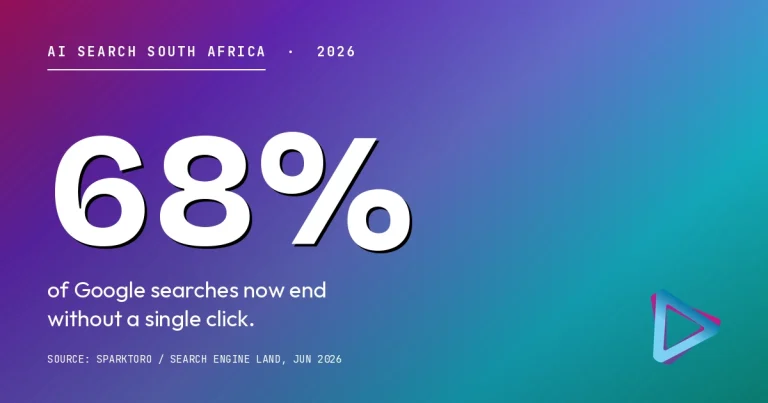
AI Search South Africa. 68% of Google searches in 2026 end without a single click – and with most Cape Town, Joburg, and Durban businesses have no idea they’ve already been erased from the results page.
Something’s shifted in AI Search South Africa, and most business owners we talk to haven’t clocked it yet. Not because they’re careless. Because it happened quietly, inside a search bar that looks exactly the same as it did two years ago.
Type a question into Google today and there’s a real chance you’ll never see a website at all. The answer just appears. No click required, no scrolling, no comparing five blue links against each other like it’s 2019. We’ve been tracking this shift for our own clients since the start of 2026, and the numbers are not subtle.
Let’s start with the one that should make you put your coffee down.
South Africa Just Became Africa’s AI Leader (Whether You Noticed or Not)
The Adoption Numbers Nobody’s Talking About
South Africa is no longer the country that adopts new tech five years late. According to Microsoft’s AI Economy Institute, 23.1% of South Africa’s working-age population used a generative AI product in the first quarter of 2026 – up from 21.1% just two quarters earlier. That places us 46th out of 147 economies measured globally.
Here’s the part that actually matters: we’re first in Africa. Not close-second. First. Namibia and Botswana trail around 15%. Egypt sits at 14.8%. Nigeria, despite its far larger tech scene, comes in at 10.1%. Kenya’s at 8.7%.
(We’ll be straight with you – South Africa still lags the global leaders by a wide margin. The UAE sits above 70%. But “leading Africa” is not nothing, and it’s certainly not the story most local business owners think they’re living in.)
What 70% Chatbot Usage Actually Means for Your Customers
Adoption numbers are one thing. Behaviour is another – and this is where it gets uncomfortable for anyone still treating AI like a novelty act.
A separate Google and Ipsos study found that 70% of South African adults have now used an AI chatbot. That’s a 25-percentage-point jump since 2023. Nearly two in three – 65%, to be exact – have used AI to explore a new business venture or weigh a career change.
Read that last stat again. Explore a new business venture. That includes researching who to hire, who to trust, and who shows up when they ask a question about your industry.
The Zero-Click Problem: Inside AI Search South Africa’s Real Numbers
68% and Climbing – The Stat That Should Worry You
Globally, the picture is even starker. Fresh data from SparkToro, reported by Search Engine Land in June 2026, found that 68% of Google searches now end without a single click to any website. AI Overviews – the AI-generated summary box that now sits above traditional results – appear on more than 20% of all Google searches. And when they do show up, click-through rates to the sites underneath drop by nearly 60%.
Sit with that for a second. Two-thirds of searches, resolved, no website visited. Ever.
To be fair, we’re not claiming South Africa mirrors those exact figures – local AI Overview rollout has lagged behind the US, and query behaviour differs by market. But the direction of travel isn’t in question, and South Africa’s own adoption curve (see above) suggests we’re closing that gap faster than most local marketers assume.
Ranking #1 Doesn’t Mean What It Used To
Here’s the uncomfortable part for anyone who’s spent the last five years chasing the top spot on Google: ranking first still matters, but it’s no longer the whole game.
Think of it like a librarian who’s read every book in the building. Ask her a question and she’ll just tell you the answer out loud – she won’t necessarily point you to the shelf. You can have written the single best book in that library. If she never says your name while answering, nobody in the room finds out you wrote it.
That’s what’s happening in search right now. If a generative engine answers a question directly – and doesn’t mention your business by name – you can rank #1 on paper and still get zero traffic from that search. This is the entire premise behind Generative Engine Optimisation: getting cited inside the answer, not just linked somewhere underneath it.
We Tested It – What AI Search South Africa Actually Shows for a Cape Town Agency Search
We didn’t want to just hand you someone else’s numbers and call it a day, so we ran our own test. The query: “best web development agency Cape Town” – exactly the kind of search that’s increasingly likely to route through an AI assistant rather than a traditional search box.
The Listicle Problem
The results were dominated by third-party aggregator listicles – Clutch, GoodFirms, DesignRush – rather than agencies’ own homepages ranking on merit. Individual agency websites barely featured directly. What showed up instead were review-platform profiles and “Top 10” roundups built by sites that aren’t even in the industry.
That’s a genuinely inconvenient finding if you’ve spent years polishing your own homepage and assumed that was the whole battle. It increasingly isn’t.
One Local Competitor Already Saw This Coming
One detail stood out, and we’ll say it plainly because pretending otherwise helps nobody: at least one Cape Town competitor already lists Generative Engine Optimisation and AI visibility as an explicit service on their own site. GEO awareness is starting to spread among South African agencies themselves – not just among the clients we’re all trying to convince.
The window to build a first-mover advantage here is real. It’s also narrowing, month by month.
SEO vs AEO vs GEO vs AIO – What’s Actually Different
Four acronyms, one genuinely confused industry. Here’s the plain-English version.
SEO – Getting Ranked
Search Engine Optimisation is the foundation most people already half-understand: keywords, backlinks, technical structure – the work that gets your page ranked in Google’s classic blue-link results.
AEO – Becoming the Direct Answer
Answer Engine Optimisation structures your content so it gets pulled straight into featured snippets, voice search results, and AI Overviews. The goal isn’t a click. It’s being the answer.
GEO – Getting Cited by ChatGPT and Gemini
Generative Engine Optimisation comes down to entity clarity: does ChatGPT, Gemini, or Perplexity actually know what your business does – and will it say your name out loud when someone asks a relevant question?
AIO – Owning the Whole Category
AI Optimisation ties the other three together into one ongoing strategy instead of three separate projects fighting each other for budget and attention.
None of these replace the others, and we’d be lying if we said otherwise. SEO remains the foundation – without a fast, technically sound website, AEO and GEO have nothing solid to build on. The businesses winning in 2026 aren’t picking one lane. They’re running all four as a single, connected effort.
Three Things to Check This Week
You don’t need a six-month strategy document to get started. Three things, in order of impact:
- Ask an AI assistant about your own industry, in your own city. Not your business by name – the general question a real customer would actually type. If you don’t show up, now you know exactly where you stand.
- Check whether your service pages actually say what you do, in plain language. AI systems reward clarity over cleverness. A homepage full of “innovative solutions” and “cutting-edge strategies” tells a generative engine almost nothing useful about your business.
- Look for your business on the third-party platforms your industry actually uses – Google Business Profile, relevant directories, review sites. Citation from outside your own website carries real weight with generative engines, much the same way it does with human trust.
None of this replaces a proper GEO strategy. But it’ll tell you, within the hour, whether you’re genuinely invisible or just under-optimised.
FAQ – What SA Business Owners Are Actually Asking
Is Google really sending less traffic in South Africa? Locally, this shift is earlier-stage than in the US or UK – but the direction is the same. As AI Overviews roll out to more markets and more query types, expect the zero-click share to keep climbing here too. We’ve seen this pattern play out before with revenue leaks that don’t show up until you go looking for them.
Do I have to choose between SEO and GEO? No, and trying to would be a mistake. GEO builds directly on top of solid SEO fundamentals. Neglect one to chase the other and you’ll likely lose ground on both.
How long does GEO actually take to work? Realistically, a few months of consistent, well-structured, properly-cited content before you see meaningful movement in AI citations. There’s no shortcut here – and anyone promising overnight results is selling you something else entirely.
What’s the first thing we should actually fix? Start with your site’s technical foundation and clear, specific service pages – AI systems can only cite what they can read and understand cleanly. From there, build outward: structured content, third-party citations, and consistent monthly publishing.
Where This Leaves You (Real Talk)
Nobody can promise you the #1 spot in AI search results, and we’re not going to pretend otherwise. Anyone who tells you differently is guessing, or lying, or both. What we can tell you, with real data behind it, is this: businesses still writing content purely for Google’s blue links in 2026 are optimising for a search experience that’s already shrinking under their feet.
The uncomfortable question isn’t “are we ranking.” It’s “when someone asks an AI about businesses like ours, do we get mentioned at all.”
For most South African SMEs right now, the honest answer is no. That’s not a scare tactic – it’s what the data above actually shows. What you do with that is entirely up to you.
We’re genuinely curious: are you already seeing AI search show up in your own traffic numbers, or does all of this still feel theoretical from where you’re sitting?
Sources: Microsoft AI Economy Institute (Global AI Diffusion Q1 2026) – Google & Ipsos, “Our Life with AI” (2026), via ITWeb – SparkToro zero-click search data, via Search Engine Land (June 2026)