

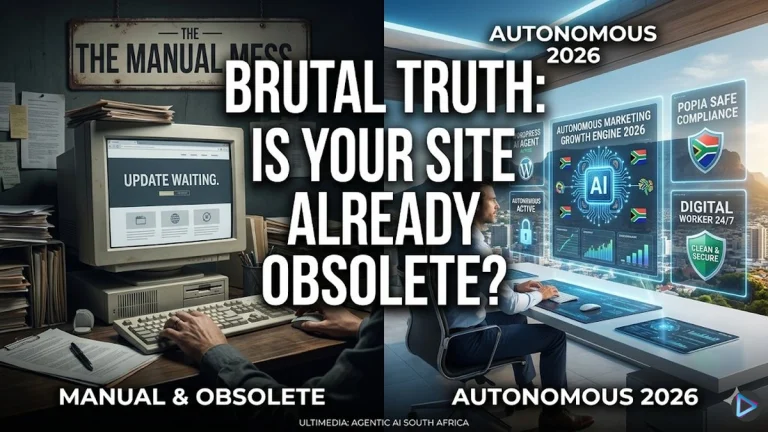
Autonomous digital marketing 2026 isn’t a buzzword-it’s the dividing line between businesses that scale and businesses that stall.
Here’s a stat that should make you squirm: 60–74% of the answers AI models spit out come straight from the top search results. If your site isn’t in that mix-visible, fast, and machine-readable-you’re not just losing traffic. You’re invisible and invisibility in the era of autonomous digital marketing 2026? That’s a slow death.
We’re UltiMedia. We’ve took time building Agentic AI WordPress South Africa systems that don’t just sit there looking pretty-they work. Real, measurable, round-the-clock work. And the shift we’re seeing with autonomous digital marketing 2026? It’s not hype. It’s the first genuine leap in how websites operate since mobile responsiveness became a thing.
Autonomous Digital Marketing 2026: Your Site’s Been Dumb. That’s About to Change.
Let’s be honest-most WordPress sites are glorified brochures. They wait. They sit. They do exactly nothing until you log in and tell them what to do. That setup was fine in 2019. In the world of autonomous digital marketing 2026, it’s embarrassing
WordPress AI agents have quietly become the most underrated weapon in digital marketing. These aren’t the clunky chatbots your cousin installed and forgot about. We’re talking about autonomous systems that read your site’s behaviour, make decisions, and act-without you touching a thing.
In our experience, the biggest mindset shift businesses need to make is this: stop treating AI like a tool you poke and start treating it like a team member who shows up before you do.
The distinction matters. We covered it in detail here: What Is an AI Agent for Business? the short version? A chatbot waits for instructions. An agent spots the opportunity and takes it.
How WordPress Became the Brain of the Operation
WordPress caught a massive upgrade in early 2026. The Model Context Protocol (MCP)-think of it as a universal translator between AI and your website-now let’s agents write, edit, publish, and manage your content directly.
This isn’t a beta feature. It’s live. And it’s the engine underneath any serious autonomous digital marketing 2026 strategy worth its salt.
Your site can now:
- Read the room. A visitor lands on your pricing page and hesitates. The site tweaks the messaging-softer tone, simpler language-right then and there.
- Spot the winner. One product starts getting traction in your analytics. Your homepage updates itself to feature it. No meeting. No Slack message. Just action.
- Fix itself. A bloated image slows your load time. The agent catches it, compresses it, and logs the fix. You find out about it in a report, not a panic.
We’ve written extensively about this self-evolving architecture here: Agentic AI WordPress Autonomy Secrets 2026.
The Old SEO Playbook is Dead. Good Riddance.
For years, SEO was a game of keywords and backlinks. That game’s over. AI models-Gemini, Perplexity, ChatGPT-don’t rank pages. They cite sources.
And here’s the kicker: they’re picky. They want unique data, clear authority, and content that doesn’t smell like it was churned out by a machine. If you’re publishing the same thin listicles everyone else is, you’re shouting into the void. In the landscape of autonomous digital marketing 2026, your content either earns citations, or it doesn’t exist.
This new discipline is called Generative Engine Optimization (GEO). We wrote the playbook-literally. The short version: build content so fact-dense and source-rich that AI models can’t afford to ignore you. When your autonomous agents are the ones creating that content at speed, the citation flywheel spins itself.
Your Ads Should Run Themselves (And They Can)
Here’s something we’ve noticed after years of running campaigns: humans are terrible at the boring bits. We get lazy. We forget to pause underperforming ads. We let budgets bleed into channels that stopped converting three weeks ago.
Agents don’t.
Autonomous campaign optimization is the quiet revolution nobody’s talking about loudly enough. These systems watch your campaign data in real time-CPCs, conversion rates, audience fatigue signals-and adjust bids, creative variations, and budget allocation without waiting for your approval. This is what autonomous digital marketing 2026 looks like in practice: machines handling the grind, humans focusing on the vision.
Google’s entire infrastructure is bending toward this reality. We dug into the technical side here: Google’s Agentic Infrastructure. But for you, the takeaway is simple: if you’re still manually managing campaigns in 2026, you’re paying a human to do what a system can do faster, cheaper, and without ego.
The Boring Stuff That Keeps You Out of Court
Nobody wants to read about compliance. I get it. But here’s the reality in South Africa: AI governance POPIA violations aren’t a slap on the wrist. They’re existential.
Section 71 of the POPIA Act regulates automated decision-making directly. If your AI makes choices about customers-personalising content, adjusting offers, flagging behaviour-without a human in the loop, you need a paper trail. A clear one. South Africa’s draft AI policy, up for public comment until June 2026, doubles down on this: explainability, data protection by design, and accountability for high-risk systems.
At UltiMedia, we don’t bolt compliance on after the fact. We bake it in:
- Every decision gets logged. If a regulator asks why your AI changed a price or targeted a specific user, we can point to the exact data signal that triggered it. No black boxes.
- Data minimisation isn’t a slogan. Our agents are instructed to grab only what they need. If a piece of personal info isn’t essential to the task, it’s not collected. Period.
- Security is the foundation. You can’t build autonomous systems on shaky ground. We make sure the base is solid before anything goes live.
The Bigger Picture (Yes, It Gets Bigger)
Where’s this all heading? The conversation eventually lands on ASI and AGI-Artificial Superintelligence and Artificial General Intelligence. They sound like sci-fi, but the trajectory is real.
The practical point: build your infrastructure now. The businesses running agent-ready architecture today are the same ones that’ll plug into the next intelligence leap without missing a beat. Everyone else will be playing catch-up-again.
So, What’s It Going to Be?
Here’s the uncomfortable truth: your website is either an asset that works while you sleep, or it’s a liability you’re babysitting. There’s no middle ground anymore.
We’ve seen South African businesses make this shift in 2026. The ones who get it stop treating their site like a cost centre and start treating it like their highest-performing employee. The ones who don’t? They’re still logging in at 10pm to update a hero image nobody’s clicking on. Autonomous digital marketing 2026 isn’t waiting for them-and it won’t wait for you either.
The competition isn’t waiting. They’re already deploying digital workers that don’t take lunch breaks, don’t forget to follow up, and don’t spend mornings scrolling LinkedIn.
So ask yourself-and be hones-if your website vanished tomorrow, would your customers even notice? Or is it already invisible because it can’t think for itself?
Drop a comment. Let’s have the real conversation.