

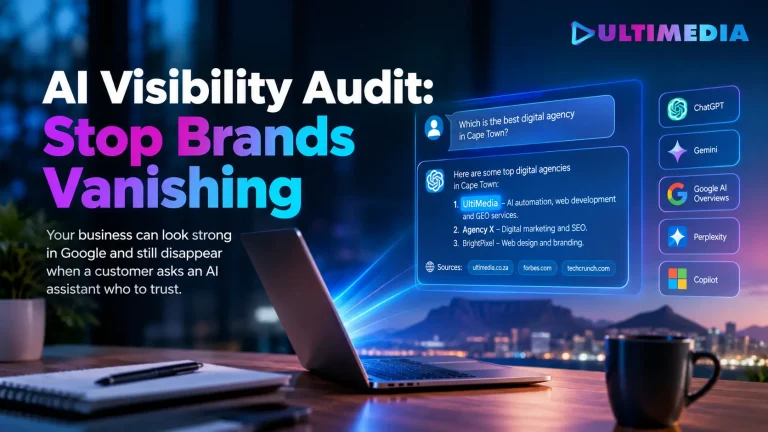
AI Visibility Audit: Stop Brands Vanishing 2026
Your business can look strong in Google and still disappear when a customer asks an AI assistant who to trust.
An AI visibility audit measures how ChatGPT, Gemini, Google AI Overviews, Google AI Mode, Perplexity and other answer systems describe your business.
It checks whether they mention you, recommend you, cite your website, cite another source or leave you out. Those are not the same result. Treating them as one number is how marketing reports grow teeth but lose meaning.
We have seen businesses celebrate one flattering AI response as proof that their strategy works. Let’s be honest: one screenshot is not a strategy. It is one screenshot.
What an AI visibility audit measures
A proper audit uses a fixed group of real customer questions and tests them across relevant AI platforms.
It records:
- Whether the brand appears.
- Whether the platform recommends it.
- Whether the brand’s website is cited.
- Whether other sources are cited.
- Whether the facts are accurate.
- Whether competitors appear instead.
- Whether the result changes across platforms or repeated tests.
The short answer
An AI visibility audit measures whether AI search platforms mention, recommend or cite a business for relevant customer questions. It should test several platforms, preserve the exact prompts and answers, identify every source, and report brand mentions, recommendations, citations and accuracy as separate results.
That last part matters. A platform may cite a page without naming the business. It may name the business without citing its own website. It may recommend a company while relying on an outdated directory entry.
Three doors. Three different problems.
Why one platform cannot tell the whole story
AI search does not behave like one giant search engine with one universal results page.
Different systems use different models, retrieval methods, indexes and source-selection processes. The same brand can appear in one answer engine and vanish from another.
A September 2026 Tech Times analysis described a study covering 596,723 prompts answered by at least two of five AI engines: ChatGPT, Gemini, Perplexity, Google AI Overviews and Google AI Mode. It reported that only 10.2% of cited URLs appeared on more than one engine, while brand names appeared across engines more often. The study separated three events that marketers often mix together: retrieval, citation and mention. Read the Tech Times analysis and methodology.
The same analysis reported that brand names recurred across engines at 67.4%, compared with 10.2% URL-level citation overlap in the dataset. These figures describe that study’s sample. They are not a universal rate for every industry, country or platform. Read the full analysis.
The practical lesson is simple:
A brand can have broad recognition but narrow citation coverage.
That is why an audit must measure the brand and the evidence separately.
A mention is not a recommendation
Here is the difference:
| Outcome | Meaning | What it tells you |
|---|---|---|
| Mention | The brand name appears | The system recognised the entity |
| Recommendation | The brand appears as a suitable choice | The brand entered the shortlist |
| Citation | A source is linked or identified | The answer has visible supporting evidence |
| Accurate mention | The facts are correct | The public information is working |
| Incorrect mention | The facts contain an error | The evidence needs repair |
A company may be mentioned because the model has seen its name before. That does not prove the company is being recommended for the right reasons.
A company may be cited because a page contains useful information. That does not mean the platform endorses the business.
A recommendation is commercially interesting, but it still does not guarantee a lead, sale or good customer experience.
In our experience, this is where many dashboards become a little too cheerful. They combine every positive signal into one score and call it “AI authority.” We prefer to keep the parts visible.
Why this matters in South Africa
South African customers ask local, practical questions:
- “Who is the best web development agency in Cape Town?”
- “Which company provides AI automation in South Africa?”
- “Who can deploy a private LLM for a local business?”
- “Which ecommerce agency understands South African payments?”
- “What is the best GEO agency near me?”
These queries contain more than a service keyword. They contain place, trust, fit and buying intent.
For a business to appear in a useful answer, an AI system needs to connect several facts:
- The business exists.
- It offers the requested service.
- It serves the requested location.
- Its information is current.
- Its claims have supporting evidence.
- Public sources describe the business consistently.
A company may appear for “what is generative engine optimisation?” and still disappear for “who offers GEO in Cape Town?”
That is not a small wording difference. The first is informational. The second is commercial and local.
How to run an AI visibility audit
You can run a meaningful first audit with a prompt list, several AI platforms and a spreadsheet.
You do not need to begin with an expensive software subscription. You need a repeatable method.
Step 1: Select real customer questions
Create 10 to 20 questions that buyers might ask before contacting your business.
Use several groups.
Category questions
- “What are the best AI automation agencies in South Africa?”
- “Which companies provide GEO services in Cape Town?”
Comparison questions
- “[Your brand] versus [competitor]: which is better for a small business?”
- “What are the alternatives to [competitor] for a South African company?”
Trust questions
- “Is [your brand] a legitimate business?”
- “What do customers say about [your brand]?”
Service questions
- “Who can build an AI agent for a South African ecommerce business?”
- “Which agency can deploy a private LLM?”
Local questions
- “Who is the best web development agency near Cape Town?”
- “Which digital agency serves businesses in the Western Cape?”
Do not write questions that make your business look good. Write questions customers might actually use.
Otherwise, you are marking your own test paper.
Step 2: Test relevant AI platforms
Use the platforms your audience may use, such as:
- ChatGPT.
- Google Gemini.
- Google AI Overviews or AI Mode, where available.
- Perplexity.
- Microsoft Copilot.
Record the following for each test:
- Platform.
- Date and time.
- Country or location setting.
- Account status, where relevant.
- Search or browsing mode.
- Exact prompt.
- Full answer.
- All cited sources.
The aim is not to make every platform identical. They are not identical. The aim is to record the conditions well enough to compare the results honestly.
Step 3: Save the complete response
Do not record only “yes” or “no.”
Save the complete response and identify:
- Brand mentions.
- Recommendations.
- Competitors.
- Cited URLs.
- Incorrect claims.
- Outdated claims.
- Missing services.
- Wrong locations.
- Repeated source domains.
A source list can reveal more than the answer itself. If the same weak directory appears repeatedly, that is a different problem from being cited by a respected industry publication.
Step 4: Repeat the prompts
One answer is an observation, not a trend.
The Tech Times analysis reported that AI systems used largely different citation pools, even when they produced similar brand shortlists. Its methodology also noted that prompt date, engine and sampling method affect what the results mean. See the study’s discussion of retrieval, mentions and citations.
Repeat each important prompt at a consistent interval.
You can calculate simple measures:
- Mention rate: Answers mentioning your brand divided by valid answers.
- Recommendation rate: Answers recommending your brand divided by valid answers.
- Owned citation rate: Answers citing your website divided by answers with visible citations.
- Accuracy rate: Accurate brand answers divided by answers mentioning your brand.
Always show the denominator. A 100% recommendation rate from two tests tells you less than a 40% rate from 50 well-designed tests.
What to fix after the audit
Start with factual problems. They cause more damage than a missing adjective.
Correct wrong information
Check:
- Business name.
- Founder information.
- Service offerings.
- Locations.
- Contact details.
- Opening hours.
- Pricing statements.
- Qualifications.
- Case studies.
- Publication dates.
If the answer says you serve Johannesburg but you only serve Cape Town, correct the public source. Do not publish five new pages hoping the error gets buried under fresh words.
Clarify the business entity
Make it clear that your organisation, people, services and locations connect to one real business.
For UltiMedia, that means keeping important facts consistent:
- UltiMedia is a Cape Town-based digital agency.
- We provide AI automation and GEO services.
- We work with local and broader markets.
- Our services include AI automation, GEO, local and private LLM deployment, web development and ecommerce integration.
- Our founder and technical work have identifiable public profiles.
You can review UltiMedia’s AI Automation service and Generative Engine Optimisation service for examples of how these offerings are presented.
For founder and technical authority, see our LinkedIn profile and GitHub profile.
Strengthen service pages
A useful service page answers:
- What is the service?
- Who needs it?
- What problem does it solve?
- What does the process involve?
- What does it not do?
- What evidence supports the claim?
- What should the buyer do next?
Relevant UltiMedia pages include:
- Local LLM deployment and integration.
- Private LLM deployment and integration.
- Web development.
- Ecommerce integration and automation.
These pages should support the buyer’s next question. Internal links are useful when they help a reader move from an explanation to a relevant service. They are not useful when they are sprinkled into every sentence like confetti.
Publish evidence, not fog
Useful evidence includes:
- A properly explained case study.
- A documented implementation.
- An original survey with its method.
- A technical article.
- A clear service comparison.
- An expert interview.
- A measured result with a defined time period.
Explain what was measured, when it was measured and what it does not prove.
Do not turn correlation into causation. Do not turn a small test into a universal promise. AI search already contains enough confident nonsense without adding another shovel.
Website content still matters
Some marketers now claim that websites no longer matter because AI systems prefer third-party sources. That claim is too simple.
Your website remains the place where you control the core facts:
- Who you are.
- What you provide.
- Where you operate.
- Who is responsible.
- What your process involves.
- What your services cost or exclude.
- What evidence you can show.
A website cannot guarantee an AI recommendation. A weak website can make an accurate recommendation harder.
Google’s official documentation says that pages eligible for supporting links in AI Overviews and AI Mode must be indexed and eligible to appear in Google Search with a snippet. Google also says there are no additional technical requirements for these AI features. Read Google Search Central’s guidance on AI features.
Google recommends the same basic foundations used in ordinary Search, including crawlability, internal links, useful text, good page experience, accurate structured data and up-to-date Business Profile information. It also states that there is no special schema required for AI Overviews or AI Mode. Read Google’s official recommendations.
That matters because it cuts through a common sales pitch. There is no magic “AI schema” button that guarantees a citation.
Clear content, technical access, accurate structured data and genuine evidence remain the sensible foundation.
Third-party sources need judgment
AI systems may cite:
- News sites.
- Industry publications.
- Review platforms.
- Community discussions.
- Directories.
- Partner pages.
- Professional organisations.
- Company websites.
A citation is not automatically good because an AI system selected it.
Check:
- Is the source relevant?
- Is the information current?
- Does it identify the business correctly?
- Does it make unsupported claims?
- Does it have a clear editorial or business purpose?
- Is it an obvious machine-generated content farm?
A September 2026 report on AI citations warned that large volumes of machine-made pages can enter the citation ecosystem, including networks that publish content mainly to be retrieved by machines. Read the reporting on manufactured AI citation pages.
We would not treat every figure in that report as a universal benchmark. Its underlying warning is sound: more citations do not automatically mean better authority.
If a page exists only to repeat marketing claims, it is not strong evidence. It is just a louder claim.
A practical South African checklist
For a local business, review these items first.
Business identity
- Official business name.
- Consistent website URL.
- Correct telephone number.
- Accurate address or service area.
- Clear ownership and contact information.
Local profiles
- Correct Google Business Profile category.
- Current opening hours.
- Genuine photographs.
- Relevant services.
- Honest reviews.
- Helpful owner replies.
Website content
- Clear service pages.
- Location information.
- Staff or founder details.
- Contact information.
- Case studies.
- Policies and limitations.
- Updated dates where they matter.
Technical access
- Important pages are indexable.
- Robots.txt does not block key resources.
- No accidental noindex tags.
- Canonicals point to the right URLs.
- Mobile pages work properly.
- Internal links connect related pages.
- Structured data matches visible content.
AI measurement
- Fixed prompt set.
- Several relevant platforms.
- Saved full answers.
- Recorded citations.
- Separate mention and recommendation rates.
- Accuracy checks.
- Regular retesting.
How UltiMedia fits
We build digital systems that need to work for people and machines.
UltiMedia’s relevant capabilities include:
- AI automation and autonomous workflows.
- Generative Engine Optimisation.
- Local LLM deployment.
- Private LLM deployment.
- Web development.
- Ecommerce integration and automation.
If a business needs automation, see UltiMedia’s AI Automation service.
If the problem concerns how a brand appears in AI answers, see Generative Engine Optimisation.
If the business needs a controlled AI environment, see Local LLM deployment or Private LLM deployment.
You can also reach out to us directly at 068 681 9277 to discuss an AI visibility audit for your brand.
For related reading, we also publish material on what an AI agent is for business, agentic AI and SEO automation and how to stop prompting and start architecting.
The sensible starting point is not “make us number one everywhere.”
Nobody can promise that honestly.
The sensible starting point is:
- Define the questions that matter.
- Test the platforms customers use.
- Save the answers and sources.
- Find factual gaps.
- Repair the underlying information.
- Publish useful evidence.
- Test again.
That process is less shiny than a giant AI score on a sales deck. It is also much harder to fake.
Frequently asked questions
What is an AI visibility audit?
An AI visibility audit measures whether AI search systems mention, recommend or cite a brand for relevant customer questions. It records the exact prompt, platform, date, answer, cited sources and whether the information is accurate.
Why can a brand appear in ChatGPT but not Gemini?
AI platforms use different models, retrieval systems, indexes and source-selection processes. A brand can therefore appear in one platform’s answer while being absent from another platform’s response to a similar question.
Is traditional SEO still important for AI search?
Yes. Search eligibility, crawlability, clear information and useful content still matter. Traditional SEO does not guarantee an AI recommendation, but technical and content quality can affect whether a system can find and understand a brand.
Is a brand mention the same as a citation?
No. A mention means the brand name appears in the answer. A citation identifies or links to a source. A recommendation presents the brand as a possible choice. These outcomes should be measured separately.
How often should a business run an AI visibility audit?
Start with a baseline, then repeat the same important prompts at a consistent interval. Retest after a major launch, rebrand, negative news event, website change or significant update to public business information.
Can a business control what an AI system says about it?
No. A business cannot directly control every AI answer. It can improve the available evidence by keeping first-party information accurate, maintaining legitimate listings, publishing useful content and earning credible third-party references.
The uncomfortable truth
The old question was, “Where do we rank?”
The better question is, “When a customer asks an AI assistant for help, does it understand who we are, trust the evidence and include us in the answer?”
That question connects SEO, local search, reputation, public relations, structured data, content quality and entity clarity. No single trick can manufacture trust.
- The brands that improve their AI visibility will not necessarily be the brands shouting the loudest about AI. They will be the brands with clear facts, useful pages, honest proof and a public presence that does not contradict itself.
So run the audit. Save the answers. Check the sources. Fix the facts.
And stop calling one lucky ChatGPT response a strategy.