

Research updated: 31 October 2026 | By UltiMedia
AI agent memory vs RAG is more than a technical comparison. It determines whether a business assistant can retain useful history, retrieve current evidence and use the right facts when making decisions.
Everyone wants an AI agent that remembers everything, finds the right answers and makes intelligent decisions.
Fair enough.
But behind every impressive demonstration sits a much less glamorous engineering problem: where does the agent get its information, what should it remember and how does it decide which facts deserve its attention?
The answer involves three connected disciplines: memory, retrieval-augmented generation and context engineering.
Confuse them, and your expensive AI assistant can become a very confident source of outdated information.
Build them properly, and you have the foundations of a system that can retrieve evidence, maintain continuity and handle business tasks with fewer preventable mistakes.
AI Agent Memory vs RAG vs Context Engineering: What Is the Difference?
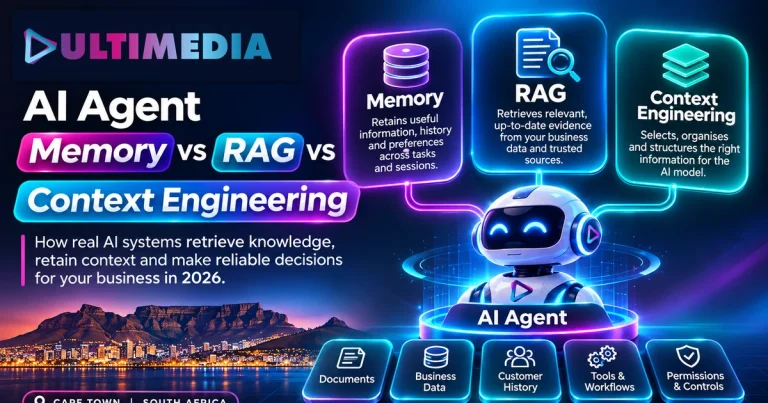
AI agent memory stores useful information across steps or sessions. Retrieval-augmented generation (RAG) finds external evidence when a question needs it. Context engineering decides which instructions, retrieved facts, tool results and memories reach the model. Reliable systems combine these techniques with permissions, freshness checks, citations and controlled actions.
The distinction matters because these technologies solve related but different problems.
- Memory: What information should the agent retain?
- RAG: What evidence should the agent retrieve now?
- Context engineering: What information should the model receive to complete this specific task?
Here is the detail most introductions miss: these are not mutually exclusive technologies.
An AI system can use RAG to retrieve its own saved memories. It can also use context engineering to decide which retrieved memories and documents to include.
Think of them as three responsibilities within one information system. The AI agent memory vs RAG distinction is about retained continuity versus on-demand retrieval, while context engineering determines what the model sees.
Prefer to watch? Memory and context in production AI
Discover how production AI agents manage short-term information, retain useful history and select relevant context. This UltiMedia explainer also examines the safeguards needed when agents interact with business systems.
Why AI Agents Fail in Production (And How to Fix Them) · 8-minute explainer
Jump to the memory and context chapter (04:14)
Explore the complete UltiMedia AI Systems Explained YouTube playlist
The video focuses on production architecture and context management. Continue reading for the detailed differences between agent memory, RAG and context engineering.
1. AI Agent Memory: What Should the System Remember?
In an AI agent memory vs RAG design review, begin by identifying which facts must survive a new session and which can simply be looked up again.
A language model does not automatically maintain an accurate, permanent record of every conversation or business event.
Applications need mechanisms to preserve relevant information outside the current model request. That may mean a database, saved notes, conversation transcripts, structured records or a dedicated memory service. The purpose is continuity.
Working memory
Working memory contains information relevant to the current task. Consider an AI assistant preparing a proposal for a Cape Town business.
- The client’s requested services
- The currently approved scope
- The quotation being prepared
- Missing information
- Outstanding approval steps
Some information lives in the model’s current context. Other state may live outside the model so the workflow can resume after an interruption.
Episodic memory
Episodic memory records what happened during previous interactions or tasks. For example, an agent might store that a client rejected an earlier design proposal, requested revisions and later approved a replacement.
The event history matters because the latest decision changes what the business should do next.
Semantic memory
Semantic memory contains retained facts and relationships. An assistant might know that a customer belongs to an account, uses a specified service package or has an approved communication preference.
The system must distinguish confirmed facts from assumptions and preserve information about where those facts came from.
Procedural memory
Procedural memory represents reusable procedures or lessons. For example: “When a payment webhook fails, verify the payment provider’s transaction record before attempting recovery.”
A useful procedure also needs an owner, version and review process. Otherwise, yesterday’s workaround can become tomorrow’s operational mistake.
The uncomfortable truth about memory
Saving more information does not automatically make an agent more intelligent. Old facts can conflict with new ones. Summaries can omit important details. A remembered preference may no longer apply.
Capture → Validate → Store → Retrieve → Reconcile → Update or delete.
An agent should never turn a guess into a permanent customer fact simply because it appeared in a plausible conversation. For systems handling personal information, memory design also requires retention limits, deletion controls and carefully defined access permissions.
2. RAG: How an AI System Retrieves Knowledge
The AI agent memory vs RAG difference becomes clearer when a customer’s question requires an up-to-date policy rather than a remembered conversation.
Retrieval-augmented generation allows an AI application to obtain external information and provide it to a model when generating a response.
The original RAG research by Patrick Lewis and colleagues appeared in 2020. It combined model-based knowledge with an external information-retrieval mechanism. Source: Retrieval-Augmented Generation for Knowledge-Intensive NLP Tasks.
In practical business systems, retrieval may search:
- Company documents and policy manuals
- Product catalogues and technical specifications
- Customer support knowledge bases
- Relevant database records
- Approved project documentation
- Historical conversations, when permission allows
A common implementation divides documents into passages, converts them into numerical embeddings and stores searchable representations. When the user asks a question, the system retrieves potentially relevant passages, may rerank them and supplies selected evidence to the language model.
But RAG does not require a vector database in every implementation. Keyword search, database queries, hybrid search and other retrieval methods can all contribute to an evidence-grounded system.
Example: A customer asks about a refund
Imagine an online customer asks: “Can I return my order after 14 days?”
A basic chatbot may answer from general knowledge. A retrieval-enabled assistant can search the current merchant-approved returns policy, identify the relevant conditions and respond using that evidence.
But what happens when the policy changes tomorrow? The retrieval system must discover the updated version, avoid obsolete passages and identify which rules apply to the customer’s actual purchase.
The difference between finding a document and finding an answer
A search result can be relevant without containing enough evidence to answer a question. Google Research examined this problem in its May 2025 work on sufficient context, exploring methods that help models abstain rather than manufacture answers. Source: Google Research – Sufficient Context.
An assistant that cannot verify a refund condition should say what remains unknown and request the missing information. It should not improvise a policy.
3. Context Engineering: Deciding What the AI Actually Sees
Context engineering connects the AI agent memory vs RAG discussion: even a correct memory or search result is useless if the model never receives it at the right moment.
You can build a capable retrieval system and carefully maintain long-term memory, yet still send the model the wrong information. Context engineering addresses this problem.
It determines what information reaches the model for a particular step, in what structure and with what priority.
- System and developer instructions
- The user’s current question
- Selected conversation history
- Retrieved source passages
- Approved memory records
- Current tool results
- Task state and output requirements
In September 2025, Anthropic published an engineering analysis explaining why effective AI applications increasingly require careful management of their entire context rather than simply better-written prompts. Source: Anthropic – Effective Context Engineering for AI Agents.
Why enormous context windows do not solve everything
Instead of retrieving a few documents, why not insert the entire knowledge base into the model’s context?
Because the ability to accept a large input does not guarantee the ability to use every part of it reliably. A 2024 study in Transactions of the Association for Computational Linguistics found that language models often performed worse when important information appeared in the middle of long inputs, a phenomenon called lost in the middle. Source: Liu and colleagues – Lost in the Middle.
A larger context window may help some tasks, but it does not remove information-quality problems. Sending thousands of irrelevant tokens can increase cost and obscure the facts that matter.
Context engineering is not about giving the model everything. It is about giving it the right information for the decision in front of it.
4. What October 2026 Research Reveals About AI Memory
Recent research makes the AI agent memory vs RAG debate especially interesting because sophisticated storage does not guarantee better answers.
On 22 October 2026, researchers Zhengye Bao and colleagues released a preprint titled Is Complex Agentic Memory Always Needed? Naive RAG Is Stronger Than We Thought.
The Raw-RAG approach retrieves relevant passages from original conversation histories using dense retrieval and reranking. Across the evaluated benchmark-model settings, it ranked first among the compared memory systems in six out of seven settings. The reported advantages over the strongest compared agentic memory systems ranged from 0.13 to 5.53 points. Source: Bao et al., arXiv:2610.30755, October 2026.
There is an important qualification: this research preprint evaluated particular systems, models and benchmarks. It does not prove that basic retrieval always beats structured memory in production.
Preserving original evidence may be more valuable than endlessly summarising it into elaborate memory structures.
Complexity needs to earn its place. We would rather see a simple retrieval baseline properly measured than a sophisticated memory platform chosen because its architecture diagram looks impressive.
What this means for your business
Before buying or building a dedicated long-term memory platform, test a simpler alternative. Store original permitted conversation history, index it appropriately and retrieve relevant evidence when needed.
Then compare that baseline with a structured memory system. Measure answer quality, freshness, access control, operational cost and recovery behaviour. If the more complicated system performs better on your actual tasks, there is a strong reason to adopt it.
5. How Memory, RAG and Context Engineering Work Together
The best answer to AI agent memory vs RAG is often to use both, with clear rules about which system owns the authoritative facts.
Consider a fictional Cape Town e-commerce company that wants an AI customer support assistant. A customer writes: “I changed my delivery address last week. Where is my parcel going?”
Step 1: Identify the customer and confirm access
The application verifies the authenticated customer’s identity and determines which orders they are entitled to access.
Step 2: Retrieve current operational evidence
A trusted integration checks the current order record, delivery destination and fulfilment status. The system may also retrieve the courier’s latest tracking event.
Step 3: Consult relevant history
The assistant retrieves the customer’s earlier delivery-address request and any recorded acknowledgement. That history provides context, but it does not automatically override the authoritative order record.
Step 4: Assemble the context
The application selects the latest relevant records, applicable business rules and task instructions. It excludes unrelated customers’ data and obsolete information.
Step 5: Verify and respond
The assistant compares the address-change request with the current fulfilment record. If the two disagree, it reports the discrepancy instead of pretending to know the final delivery destination. If an address correction is still possible, a separately authorised workflow handles that action.
The language model provides the explanation. Business systems remain responsible for the underlying records and transactions.
6. A Practical Architecture for Reliable Business AI
Here is a reference architecture we would consider when designing an assistant that needs access to company knowledge and retained task history.
Layer 1: Identity and access control
Authenticate users, establish account boundaries and enforce permissions before retrieving sensitive records.
Layer 2: Knowledge ingestion
Collect approved documents, clean the content, capture metadata and retain the source version.
Layer 3: Retrieval services
Use keyword, semantic or hybrid search, with reranking where testing shows a benefit. Enforce document-level access restrictions.
Layer 4: Memory services
Preserve relevant interactions, state transitions, confirmed facts and reusable procedures. Include mechanisms for correction, expiry, deletion and audit history.
Layer 5: Context assembly
Select the minimum useful information for the task, respecting source authority, freshness, permissions and available context capacity.
Layer 6: Model and tool orchestration
Use the language model to reason over permitted information and request approved tools when necessary.
Layer 7: Verification and action controls
Check evidence sufficiency, validate structured outputs, enforce business rules and require appropriate approval for sensitive actions.
Layer 8: Observability and evaluation
Record retrieval decisions, source versions, errors, latency, token consumption and action outcomes without exposing unnecessary personal information.
This is a proposed implementation pattern, not a claim that every company needs eight independent services. For a small business, several layers may live inside one carefully designed application.
When does agentic retrieval make sense?
Traditional retrieval often performs a single search before producing an answer. Some business questions require multiple searches across different sources.
In June 2026, Google Research described an agentic retrieval approach that breaks down complex queries and iteratively searches for sufficient evidence, reporting improvements of up to 34% on its evaluated factuality datasets compared with standard RAG. This is a benchmark result, not a universal production guarantee. Source: Google Research – Agentic RAG.
Microsoft Research also published AgenticRAG research in May 2026, exploring iterative search and evidence inspection instead of relying entirely on an initial retrieval set. Source: Microsoft Research – AgenticRAG.
Start with straightforward retrieval. Introduce multi-step exploration when your questions genuinely require it. For a broader discussion of system design, read our agentic AI architecture article and our AI agent supervisor guide.
7. Five Mistakes That Make AI Knowledge Systems Unreliable
These five avoidable errors appear on both sides of an AI agent memory vs RAG implementation, regardless of the model or database selected.
Mistake 1: Treating every memory as permanent truth
People change their minds. Business rules change. Customer records get corrected. An effective memory store must support revision, provenance and deletion.
Mistake 2: Assuming the closest search result is correct
Semantic similarity indicates a possible match, not factual authority. The correct answer may depend on an exact transaction ID, a newer policy version or information spread across several records.
Mistake 3: Allowing retrieved documents to issue commands
A retrieved webpage or PDF can contain malicious instructions. OWASP identifies indirect prompt injection as a major security risk for LLM applications. External content should remain evidence, not privileged instructions. Source: OWASP – Prompt Injection.
Mistake 4: Giving AI more permissions than the task requires
A customer support assistant should not need unrestricted database administration privileges. Reading account-specific information and changing a customer’s order are different operations with different authorisation requirements.
Mistake 5: Measuring only whether the answer sounds convincing
A fluent response can be incorrect. Production evaluation should check whether the right evidence was retrieved, whether the answer follows that evidence and whether any real-world action was permitted and executed correctly.
8. How to Test Your AI Knowledge Architecture Before Launch
We recommend building an evaluation dataset from real, appropriately anonymised business questions. Start with cases such as:
- Known answer: The correct information exists in one authoritative document.
- Missing evidence: The answer does not exist in the permitted sources.
- Outdated fact: An old policy conflicts with a newer approved version.
- Multi-source question: Answering requires evidence from two separate systems.
- Corrected memory: A customer has changed an earlier preference or instruction.
- Access boundary: The requested information belongs to another customer.
- Hostile document: Retrieved content contains instructions designed to hijack the assistant.
- Interrupted workflow: The agent resumes after a failed tool call or context reset.
Measure four separate outcomes:
- Retrieval quality: Did the system find the required evidence?
- Answer quality: Did the response accurately reflect that evidence?
- State correctness: Did the system retain and apply the right current information?
- Action safety: Did the system avoid unauthorised or duplicated business operations?
Record latency and cost alongside those measurements. This separates a model’s reasoning failure from a retrieval failure, a memory error or a broken integration.
9. Why This Matters for South African Businesses
South African businesses often manage information across WordPress, WooCommerce, CRMs, email, shared documents and payment providers.
The engineering problem is not simply connecting everything to an LLM. It is deciding which application owns the authoritative record and ensuring that each retrieval respects the user’s permissions.
There is also a privacy consideration. The Protection of Personal Information Act (POPIA) makes responsible processing and appropriate safeguards important when AI applications handle personal information.
A private deployment can offer stronger control over where information resides, but deploying a model locally does not automatically establish compliance. Access control, purpose limitation, retention, security and deletion still matter.
For more, read our existing article on POPIA and AI compliance in South Africa. Organisations considering an internal knowledge assistant should also review our seven essential tests for private AI assistants. That article focuses on launch readiness; this one explains what happens underneath.
10. Which Approach Should You Choose?
Not every business needs a persistent memory platform. Not every assistant requires a vector database. And not every question needs an autonomous research agent.
- Questions about manuals or policies: Begin with RAG over approved documents.
- Preferences across sessions: Use permission-controlled persistent memory.
- Resuming interrupted tasks: Preserve durable workflow state and checkpoints.
- Changing knowledge collections: Use retrieval with freshness and source controls.
- Questions spanning systems: Add multi-step retrieval when justified.
- Excessive model input: Apply context engineering and compaction.
- Sensitive business actions: Require deterministic permissions and approval controls.
These choices can be combined. A mature system may use several, but architecture should grow from measured requirements rather than marketing terminology.
11. The UltiMedia Approach: Evidence Before Autonomy
At UltiMedia, we approach AI development as a systems-engineering problem. The model matters, but so do source quality, integration design and the controls that govern what happens after an answer.
Our AI Automation services focus on connecting useful business processes with appropriately designed intelligent workflows.
For organisations that need greater control over their information, our Local LLM Deployment and Integration and Private LLM Deployment and Integration services provide useful starting points.
We do not believe every client needs an autonomous agent. Sometimes a reliable workflow with a narrow knowledge base will do the job more safely and at a lower operational cost. If you are new to this subject, start with what an AI agent for business actually does.
The objective is not maximum autonomy. It is dependable outcomes.
Frequently Asked Questions
AI Agent Memory vs RAG: What Is the Difference?
AI agent memory preserves useful state, history or knowledge across steps and sessions. RAG retrieves relevant external evidence at the time of a request. They can overlap, because an agent may use retrieval to access stored memories. The distinction is their purpose, not necessarily their storage technology.
What is context engineering for AI agents?
Context engineering is the process of selecting, organizing and maintaining the information an AI model receives for each task. It includes instructions, conversation history, retrieved documents, memory, tool outputs and available context space. Its goal is to provide enough relevant information without distracting or misleading the model.
Does RAG give an AI agent long-term memory?
Not automatically. RAG provides a way to retrieve information from an external source. If that source contains retained conversations or saved agent state, retrieval can support long-term memory. The system still needs rules for saving, updating, deleting, protecting and recovering memories.
Can a large context window replace RAG?
Sometimes a large context window is sufficient for smaller, bounded tasks. It does not automatically solve freshness, access control, evidence selection or reliable use of long inputs. Retrieval remains useful when information is too large, changes frequently or must be selectively accessed.
How do businesses make AI agents more reliable?
Start with authoritative sources, permission-aware retrieval and a controlled memory policy. Then evaluate whether sufficient evidence was found, verify important claims, prevent unsafe tool actions and measure failures using realistic test questions. Require human approval for high-risk business actions.
Final Thoughts: Build AI That Knows When It Doesn’t Know
The next generation of useful business AI will not succeed because every application has the longest memory, largest vector database or most elaborate collection of agents.
It will succeed when systems can distinguish historical information from current evidence, preserve the right state and recognise when they lack enough facts to act.
The AI agent memory vs RAG question should always lead back to evidence, continuity and safe business decisions.
Memory provides continuity. RAG supplies evidence. Context engineering turns available information into a focused working input. And reliable software controls what happens next.
That is the difference between an AI demonstration and an application a business can actually depend on.
Want to build an AI assistant that works with your business data without surrendering control of your operations?
Explore UltiMedia’s AI Automation services and discuss an architecture designed around your actual workflows.