

Research snapshot: 25 November 2026 | Global data, with South African business implications
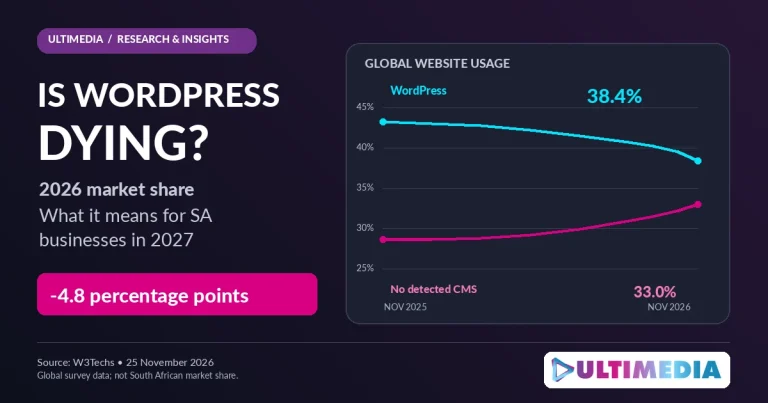
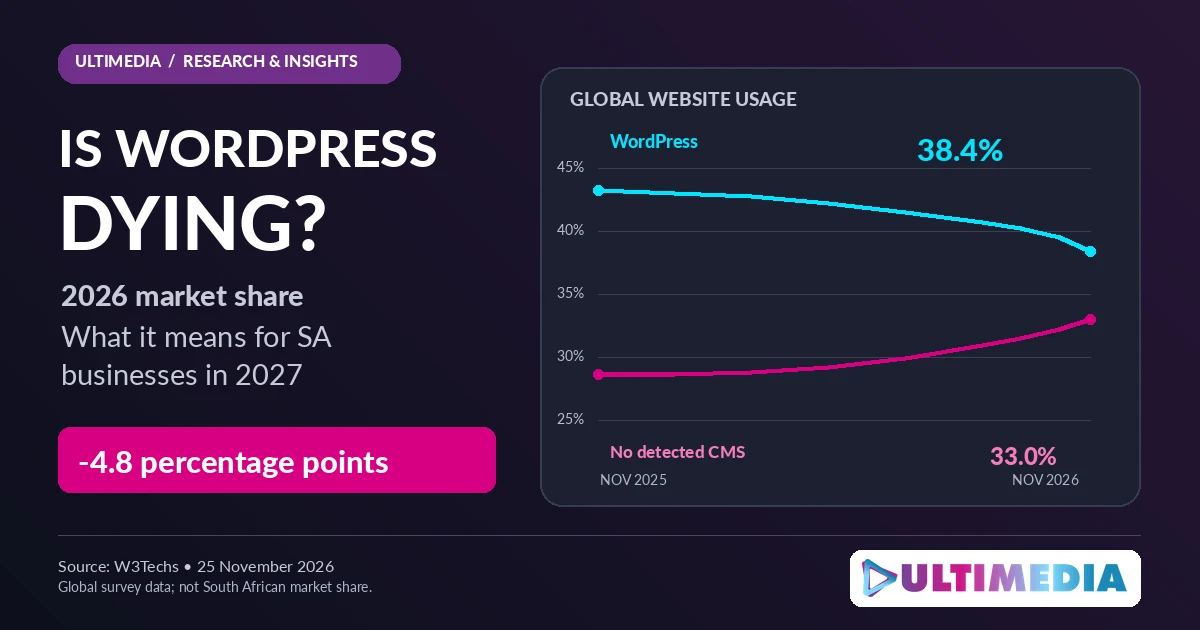
WordPress market share 2026 tells a story that deserves more than a funeral headline. WordPress now powers 38.4% of websites in W3Techs’ global survey, compared with 43.2% on 1 November 2025. Yet it still accounts for 57.3% of websites with an identified CMS. The market is changing; WordPress is not dead.
At UltiMedia, we see a more useful question for 2027: which website architecture will give your business the best balance of speed, ownership, search visibility and operating cost? A website should serve the business, not the other way around.
We are an AI-first digital agency in South Africa that builds WordPress websites and automation systems. That gives us a commercial interest in this discussion. Our analysis uses publicly available primary data, not a proprietary survey or a claim that every business should buy the same solution.
Watch the research explainer: Is WordPress dying? We break down the 2026 adoption figures, AI website builders and the platform choices South African businesses face in 2027.
WordPress market share 2026: what the numbers actually say
A Search Engine Journal report drew attention to the accelerating decline. Rather than simply repeating its headline, we checked the underlying W3Techs monthly usage series and CMS market share history.
These are two different denominators. Website usage measures the proportion of all surveyed sites using a technology. CMS market share measures its proportion among sites where W3Techs identifies a tracked CMS. Mixing those two figures produces misleading comparisons.
| Technology | Nov 2025 | Nov 2026 | Change (pp) |
|---|---|---|---|
| WordPress | 43.2% | 38.4% | -4.8 |
| No detected CMS | 28.6% | 33.0% | +4.4 |
| Shopify | 4.9% | 5.5% | +0.6 |
| Wix | 4.1% | 4.2% | +0.1 |
| Squarespace | 2.4% | 2.4% | 0.0 |
| Webflow | 0.9% | 0.8% | -0.1 |
| Lovable | Not reported | 0.6% | Not comparable |
Source: W3Techs historical usage statistics, accessed 25 November 2026. pp = percentage points. Selected categories only; not a complete market allocation.
The WordPress market share 2026 figures show a 4.8 percentage-point decrease in all-site usage, or roughly 11.1% relative to the November 2025 baseline. Among detected CMS sites, the latest figure is 57.3%, versus 60.2% on 1 January 2026. Those comparisons use different starting dates intentionally.
The decline accelerated during the year: usage reached 40.2% on 1 October, 39.5% on 1 November and 38.4% on 25 November. This is an adoption signal, not a count of businesses that abandoned WordPress.
What the survey can and cannot tell us
W3Techs’ methodology describes a sample exceeding 20 million relevant websites, excluding duplicates and sites without useful content. Its measurements reflect detected technologies and update daily. It does not count every website on Earth, survey owners’ motivations or isolate South African adoption.
WordPress market share 2026 therefore cannot establish how many migrations occurred, what caused them, or whether the absolute installed base shrank. New sites, changing detection and changes to the survey population can affect the percentages. The numbers warrant attention without proving a single cause.
Is AI website development responsible for the decline?
AI-generated websites may contribute to changing adoption patterns. But the evidence does not justify attributing the entire fall to AI. The rise in sites without a detected CMS could include hand-coded websites, static site generators, custom applications, untracked systems and sites whose technology is difficult to identify.
Lovable appears at 0.6% in the 25 November W3Techs usage series, with no comparable earlier monthly figure. That provides evidence of a measurable AI-oriented entrant, not evidence of where its users came from. Shopify’s gain is relatively modest and Wix barely moved. Treat the rest as an unanswered research question.
The future of WordPress also depends on what the project builds next. On 7 October 2026, the WordPress AI team announced the MCP Adapter’s availability in its plugin directory. On 28 October it outlined its agentic web direction, including the Abilities API and MCP. The official roadmap also prioritises responsible AI integration.
These are genuine development signals, not a guarantee of adoption or of safe autonomous operation. Our earlier analysis of agentic WordPress covers the operational side; this article focuses on the purchasing decision.
WordPress alternatives: five architectures worth comparing
WordPress market share 2026 should inform your shortlist, not dictate it. Compare the delivery model, content editing experience, maintenance obligations and exit plan. AI website builders in South Africa are a broad category: a hosted visual builder and a generated custom application have very different operating requirements.
1. Traditional WordPress or WooCommerce
Best for content-heavy businesses, editorial teams, established shops and organisations relying on mature integrations. WordPress offers an editable content model and a broad extension ecosystem. Self-hosting can support portability, provided you retain the database, media, configuration and licences.
The trade-off is ongoing patching, backups, compatibility checks and performance work. Do not install a plugin for every minor feature. See our South African WordPress maintenance cost analysis and update policy guide for operational detail.
2. Hosted CMS and commerce platforms
Shopify, Wix, Squarespace and Webflow can simplify publishing and reduce infrastructure administration. The vendor manages parts of the stack while you remain responsible for content, settings, integrations and business processes. These platforms can suit teams without dedicated developers.
Check the actual export policy before committing: Wix’s documentation explains its hosting limitations. Other vendors have different export rules. For commerce, consult Shopify’s South African payment gateway directory and verify provider eligibility, settlement currency, fees and refunds before signing a contract.
3. AI-generated standalone websites
For a campaign, simple brochure or early prototype, AI-assisted coding may dramatically shorten initial development. A static site can serve pages without a conventional CMS, and a generated application can implement bespoke interactions. Neither outcome automatically includes a good editorial workflow.
Ask for the source repository, deployment instructions, data export, environment configuration and responsibility for security fixes. Code ownership is not the same thing as control over an external authentication or database service. Review generated dependencies and test forms before accepting a site as production-ready.
4. Headless or hybrid WordPress
Keep the CMS for editors while separating the public front end, or leave WordPress rendering most pages and connect specialised services through APIs. The official WordPress REST API handbook documents a practical integration mechanism.
Headless is not automatically faster or cheaper. Preview, publishing, caching, redirects and deployment become explicit engineering tasks. A smaller hybrid integration may be the better choice when the existing website works. Our WordPress MCP architecture article explains one route for connecting AI workflows.
5. Purpose-built software
Custom software suits businesses whose competitive advantage depends on workflows that generic plugins cannot support safely: client portals, bespoke quotations, complex permissions or specialised data processing. It demands clear requirements, testing and a maintained codebase. Building ordinary contact pages from scratch rarely justifies that overhead.
Our intelligent web development and AI automation services combine these approaches where appropriate. We would rather keep a healthy existing system than sell a rebuild without a business case.
What South African businesses should demand in 2027
WordPress market share 2026 is a global signal, not a local adoption statistic. Local priorities deserve their own evidence. The Statistics South Africa General Household Survey 2025, released in 2026, reported that 85.6% of households had internet access through at least one member and location. It is not a measure of website platform usage.
Mobile performance and accessibility
Test on real mobile devices and slower connections. Make the WhatsApp enquiry, phone call, booking or checkout easy to complete. Measure Google’s Core Web Vitals: good targets are LCP at most 2.5 seconds, INP at most 200 milliseconds and CLS at most 0.1, assessed at the 75th percentile of visits. Include keyboard access, visible focus and readable contrast.
Payments and operating continuity
For stores, verify actual South African payment and delivery integrations. Test a successful purchase, declined payment, refund, duplicate webhook and reconciliation. A gorgeous homepage cannot compensate for a broken checkout. Our ecommerce integration and automation service addresses this operational layer.
POPIA, ownership and supplier exit
The Protection of Personal Information Act requires appropriate safeguards under section 19, and section 21 addresses security obligations in operator arrangements. Section 72 sets conditions on transfers of personal information outside South Africa. Overseas hosting is not automatically unlawful; review the applicable conditions with a qualified adviser.
Document data locations, vendors, retention, access permissions and the handover process. Keep domains and critical accounts under business control. Our POPIA and AI compliance article and supplier exit checks provide supporting context.
SEO, AEO and GEO must survive the platform choice
Google’s JavaScript SEO documentation explains why server rendering or pre-rendering can help users and crawlers. AI-generated sites still need unique metadata, correct status codes, canonical URLs, crawlable links and accurate sitemaps. WordPress needs these too.
Google’s AI content guidance and generative search guidance emphasise useful, accessible content rather than a platform shortcut. Our generative engine optimisation service focuses on discoverability and credible information; no platform guarantees citations.
Compare three-year ownership costs, not the first invoice
WordPress market share 2026 does not tell you which option will cost your company less. Request three-year quotes that include development, hosting, licences, support, change requests and a migration contingency. Compare the same scope and tax assumptions.
| Scenario | Setup | Monthly | 36-month total |
|---|---|---|---|
| Managed WordPress | R8,000 | R600 | R29,600 |
| Hosted builder | R5,000 | R850 | R35,600 |
| Generated custom site | R6,000 | R700 | R31,200 |
| Hybrid architecture | R16,000 | R1,000 | R52,000 |
Hypothetical arithmetic only: setup + 36 × monthly cost. Excludes VAT, payment fees, inflation, exchange-rate changes, extra work and exit costs. Not equivalent feature sets; replace assumptions with comparable quotes.
Cheap initial generation can turn expensive when a developer must reconstruct missing business logic. Conversely, a heavily customised CMS can become costly when the original requirement only needed a few fast pages. Compare the work that remains after launch.
A practical 2027 platform decision framework
Use WordPress market share 2026 as context, then score each architecture against your own requirements. Assign weights totalling 100: business fit 25, ownership and exit 20, three-year cost 20, discoverability and performance 15, security and privacy 15, editorial usability 5. Rate each option from 1 to 5 and multiply each rating by its weight divided by five. Reject any option that fails mandatory payment, accessibility, security or legal requirements, regardless of its score.
For a company with an established website, the first step is to measure, not migrate. Collect organic landing-page traffic, conversion rates, checkout errors, editorial effort, maintenance costs and backup recovery evidence. Identify the actual bottleneck. If the platform meets the requirements, improve it.
- Audit: inventory URLs, integrations, content owners, data and recurring costs.
- Shortlist: compare a retained CMS, a managed alternative and an appropriate hybrid or custom option.
- Prototype: test a representative page and critical transaction without touching production.
- Verify: check mobile usability, indexing, security, payment flows, permissions and restoration.
- Decide: approve the architecture based on measured results and a realistic ownership budget.
If you migrate, follow Google’s site migration documentation. Preserve useful URLs wherever possible, map changed URLs to relevant permanent redirects, test canonicals, submit the correct sitemap and monitor Search Console. Temporary visibility fluctuations can occur.
Three plausible 2027 outcomes
Continued CMS decline: AI-assisted and custom development expand while traditional CMS adoption loses further share. Demand for portable, maintainable sites grows.
Stabilisation: WordPress and hosted competitors improve their AI experiences while existing businesses retain familiar tools. The adoption decline slows.
Hybrid expansion: businesses keep their content and commerce systems but add custom interfaces and AI-powered services around them. CMS detection may not fully capture the complexity of these systems.
These are scenarios, not forecasts. Review the WordPress market share 2026 baseline against subsequent W3Techs reports rather than extrapolating one month into a definitive 2027 outcome.
Frequently asked questions
Is WordPress dying in 2026?
No. W3Techs measured WordPress on 38.4% of surveyed websites on 25 November 2026, down from 43.2% on 1 November 2025. It remains the largest detected CMS. The decline warrants scrutiny, but does not prove the platform will disappear or that existing WordPress websites need replacing.
What is the difference between website usage and CMS market share?
Website usage counts a technology against all websites in the survey. CMS market share counts it against websites with an identified content management system. WordPress market share 2026 is 57.3% on the latter measure and 38.4% on the former, using the November snapshot.
Are AI website builders replacing WordPress?
AI builders offer another way to create websites, but the available survey cannot identify how many WordPress sites migrated to them. The growth in undetected CMS usage includes multiple technologies. Evaluate AI-generated sites for maintainability, accessibility, technical SEO, data portability and security before deploying them.
Should South African businesses migrate from WordPress in 2027?
Not solely because of market statistics. Keep WordPress if it meets business requirements at an acceptable cost. Consider a managed alternative, hybrid architecture or custom software when specific limitations justify the change. Test the replacement and preserve search visibility before switching an established website.
Does a custom website rank better than WordPress?
No platform guarantees stronger rankings. A custom website can perform well if it provides helpful content, accessible pages, crawlable links and sound technical SEO. WordPress can achieve the same goals. Assess the actual implementation, not the technology’s reputation or the presence of AI-generated code.
Our conclusion: build for business outcomes, not platform popularity
WordPress market share 2026 shows a meaningful shift in website adoption. It does not dictate the future of your business. In 2027 the smartest architecture might be a conventional CMS, a hosted commerce platform, a generated site or a carefully engineered hybrid. The evidence and requirements should decide.
At UltiMedia, we help South African organisations choose and build the right web architecture, connect AI workflows and improve search visibility. If you are weighing a rebuild or evaluating AI website development, request a website architecture consultation with UltiMedia. Bring your current website and business objectives; start with the problem, not the platform.